10-K
0000933034falseFYhttp://fasb.org/us-gaap/2026#AccountingStandardsUpdate202309Member2028-10-312028-10-31http://fasb.org/us-gaap/2026#OtherAssetsNoncurrenthttp://fasb.org/us-gaap/2026#OtherAssetsNoncurrenthttp://fasb.org/us-gaap/2026#OtherLiabilitiesCurrenthttp://fasb.org/us-gaap/2026#OtherLiabilitiesCurrenthttp://fasb.org/us-gaap/2026#OtherLiabilitiesNoncurrenthttp://fasb.org/us-gaap/2026#OtherLiabilitiesNoncurrenthttp://fasb.org/us-gaap/2026#AccountingStandardsUpdate202309Memberhttp://fasb.org/us-gaap/2026#AccountingStandardsUpdate202309Memberhttp://fasb.org/us-gaap/2026#AccountingStandardsUpdate202309Memberhttp://xbrl.sec.gov/stpr/2026#MIhttp://fasb.org/srt/2026#ChiefExecutiveOfficerMemberhttp://fasb.org/us-gaap/2026#OtherLiabilitiesCurrent00009330342025-12-2600009330342025-06-302026-06-280000933034us-gaap:NoncontrollingInterestMember2024-07-012025-06-290000933034strt:AmendedAndRestatedJVCreditFacilityMemberus-gaap:PrimeRateMember2026-04-302026-04-300000933034us-gaap:ForeignExchangeForwardMember2025-06-290000933034us-gaap:AccountsReceivableMemberus-gaap:CustomerConcentrationRiskMemberstrt:FordMotorCompanyMember2025-06-290000933034us-gaap:CommonStockMember2023-07-032024-06-300000933034strt:ReportableSegmentMemberstrt:OtherCountryMember2023-07-032024-06-300000933034us-gaap:PerformanceSharesMembersrt:MinimumMember2025-06-302026-06-280000933034us-gaap:NonUsMemberstrt:ReportableSegmentMember2025-06-302026-06-280000933034strt:StellantisFormerlyFiatChryslerAutomobilesMemberus-gaap:AccountsReceivableMemberus-gaap:CustomerConcentrationRiskMember2025-06-290000933034us-gaap:ProductConcentrationRiskMemberus-gaap:RevenueFromContractWithCustomerProductAndServiceBenchmarkMemberstrt:ReportableSegmentMemberstrt:UserInterfaceControlsMember2023-07-032024-06-300000933034us-gaap:TreasuryStockCommonMember2023-07-032024-06-300000933034us-gaap:TreasuryStockCommonMember2025-06-290000933034us-gaap:NoncontrollingInterestMember2023-07-020000933034us-gaap:AccumulatedOtherComprehensiveIncomeMember2025-06-290000933034us-gaap:AccumulatedOtherComprehensiveIncomeMember2026-06-280000933034country:MXstrt:ReportableSegmentMember2025-06-302026-06-280000933034strt:StellantisFormerlyFiatChryslerAutomobilesMemberus-gaap:AccountsReceivableMemberus-gaap:CustomerConcentrationRiskMember2025-06-302026-06-280000933034strt:GeneralMotorsCompanyMemberus-gaap:AccountsReceivableMemberus-gaap:CustomerConcentrationRiskMember2024-07-012025-06-290000933034strt:ReportableSegmentMembercountry:CA2025-06-290000933034us-gaap:RestrictedStockMember2026-06-2800009330342026-07-310000933034strt:PowerAccessSolutionsMemberus-gaap:ProductConcentrationRiskMemberus-gaap:RevenueFromContractWithCustomerProductAndServiceBenchmarkMemberstrt:ReportableSegmentMember2024-07-012025-06-290000933034us-gaap:PostemploymentRetirementBenefitsMembercountry:MX2026-06-280000933034us-gaap:NotDesignatedAsHedgingInstrumentTradingMemberus-gaap:OtherLiabilitiesCurrent2025-06-290000933034us-gaap:CommonStockMember2025-06-302026-06-280000933034us-gaap:ProductConcentrationRiskMemberstrt:LatchesMemberus-gaap:RevenueFromContractWithCustomerProductAndServiceBenchmarkMemberstrt:ReportableSegmentMember2024-07-012025-06-290000933034us-gaap:NonUsMemberstrt:ReportableSegmentMember2025-06-290000933034us-gaap:DefinedBenefitPostretirementLifeInsuranceMember2026-06-280000933034us-gaap:AccountsReceivableMemberus-gaap:CustomerConcentrationRiskMemberstrt:TotalOfMajorCustomersMember2025-06-290000933034strt:GeneralMotorsCompanyMemberus-gaap:AccountsReceivableMemberus-gaap:CustomerConcentrationRiskMember2025-06-302026-06-280000933034strt:EmployeeStockPurchasePlanMember2026-06-280000933034us-gaap:ValuationAllowanceOfDeferredTaxAssetsMember2023-07-032024-06-3000009330342024-07-012025-06-290000933034us-gaap:RelatedPartyMember2023-07-032024-06-300000933034us-gaap:RestrictedStockMember2023-07-032024-06-300000933034strt:TwoThousandThwentyFourEquityIncentivePlanMember2026-06-280000933034strt:AftermarketAndServiceMemberus-gaap:ProductConcentrationRiskMemberus-gaap:RevenueFromContractWithCustomerProductAndServiceBenchmarkMemberstrt:ReportableSegmentMember2025-06-302026-06-280000933034strt:ReportableSegmentMembercountry:US2026-06-280000933034us-gaap:RetainedEarningsMember2025-06-290000933034us-gaap:ProductConcentrationRiskMemberstrt:LatchesMemberus-gaap:RevenueFromContractWithCustomerProductAndServiceBenchmarkMemberstrt:ReportableSegmentMember2025-06-302026-06-280000933034us-gaap:TreasuryStockCommonMember2026-06-280000933034us-gaap:PostemploymentRetirementBenefitsMembercountry:MX2023-07-032024-06-300000933034us-gaap:ForeignExchangeForwardMember2026-06-280000933034us-gaap:RetainedEarningsMember2024-07-012025-06-290000933034us-gaap:RetainedEarningsMember2025-06-302026-06-280000933034us-gaap:NotDesignatedAsHedgingInstrumentTradingMemberus-gaap:OtherLiabilitiesNoncurrent2026-06-280000933034us-gaap:SalesRevenueNetMemberstrt:GeneralMotorsCompanyMemberus-gaap:CustomerConcentrationRiskMember2023-07-032024-06-300000933034us-gaap:RelatedPartyMember2025-06-302026-06-280000933034us-gaap:ProductConcentrationRiskMemberstrt:LatchesMemberus-gaap:RevenueFromContractWithCustomerProductAndServiceBenchmarkMemberstrt:ReportableSegmentMember2023-07-032024-06-300000933034us-gaap:DefinedBenefitPostretirementHealthCoverageMember2025-06-290000933034strt:KeysAndLocksetsMemberus-gaap:ProductConcentrationRiskMemberus-gaap:RevenueFromContractWithCustomerProductAndServiceBenchmarkMemberstrt:ReportableSegmentMember2024-07-012025-06-290000933034us-gaap:AccumulatedForeignCurrencyAdjustmentIncludingPortionAttributableToNoncontrollingInterestMember2025-06-290000933034us-gaap:ProductConcentrationRiskMemberus-gaap:RevenueFromContractWithCustomerProductAndServiceBenchmarkMemberstrt:ReportableSegmentMember2025-06-302026-06-280000933034country:KRstrt:ReportableSegmentMember2023-07-032024-06-300000933034us-gaap:AccountsReceivableMemberus-gaap:CustomerConcentrationRiskMemberstrt:TotalOfMajorCustomersMember2025-06-302026-06-280000933034strt:Plan401KMember2025-06-302026-06-280000933034us-gaap:AdditionalPaidInCapitalMember2025-06-290000933034strt:StellantisFormerlyFiatChryslerAutomobilesMemberus-gaap:SalesRevenueNetMemberus-gaap:CustomerConcentrationRiskMember2025-06-302026-06-280000933034us-gaap:EarliestTaxYearMemberus-gaap:StateAndLocalJurisdictionMember2025-06-302026-06-280000933034us-gaap:SecuredOvernightFinancingRateSofrMember2025-06-302026-06-280000933034us-gaap:PerformanceSharesMember2025-06-290000933034us-gaap:AccumulatedDefinedBenefitPlansAdjustmentIncludingPortionAttributableToNoncontrollingInterestMember2025-06-290000933034strt:PowerAccessSolutionsMemberus-gaap:ProductConcentrationRiskMemberus-gaap:RevenueFromContractWithCustomerProductAndServiceBenchmarkMemberstrt:ReportableSegmentMember2025-06-302026-06-280000933034srt:MinimumMemberus-gaap:BuildingAndBuildingImprovementsMember2026-06-280000933034strt:AmendedAndRestatedJVCreditFacilityMemberus-gaap:SecuredOvernightFinancingRateSofrMember2026-04-302026-04-300000933034us-gaap:RestrictedStockMember2024-06-300000933034strt:KeysAndLocksetsMemberus-gaap:ProductConcentrationRiskMemberus-gaap:RevenueFromContractWithCustomerProductAndServiceBenchmarkMemberstrt:ReportableSegmentMember2023-07-032024-06-300000933034us-gaap:AccountsReceivableMemberus-gaap:CustomerConcentrationRiskMemberstrt:FordMotorCompanyMember2025-06-302026-06-280000933034us-gaap:RestrictedStockMember2025-06-302026-06-280000933034strt:ReportableSegmentMemberstrt:OtherCountryMember2024-07-012025-06-290000933034us-gaap:SalesRevenueNetMemberus-gaap:CustomerConcentrationRiskMemberstrt:FordMotorCompanyMember2023-07-032024-06-300000933034us-gaap:SupplementalEmployeeRetirementPlanDefinedBenefitMember2025-06-290000933034us-gaap:PostemploymentRetirementBenefitsMembercountry:MX2024-06-300000933034strt:ReportableSegmentMember2024-07-012025-06-290000933034us-gaap:AccumulatedForeignCurrencyAdjustmentIncludingPortionAttributableToNoncontrollingInterestMember2026-06-280000933034country:MXstrt:ReportableSegmentMember2026-06-280000933034us-gaap:SalesRevenueNetMemberus-gaap:CustomerConcentrationRiskMemberstrt:FordMotorCompanyMember2024-07-012025-06-290000933034us-gaap:AccumulatedDefinedBenefitPlansAdjustmentIncludingPortionAttributableToNoncontrollingInterestMember2026-06-280000933034strt:AftermarketAndServiceMemberus-gaap:ProductConcentrationRiskMemberus-gaap:RevenueFromContractWithCustomerProductAndServiceBenchmarkMemberstrt:ReportableSegmentMember2024-07-012025-06-290000933034us-gaap:NotDesignatedAsHedgingInstrumentTradingMemberus-gaap:OtherLiabilitiesNoncurrent2025-06-290000933034us-gaap:SalesRevenueNetMemberus-gaap:CustomerConcentrationRiskMemberstrt:FordMotorCompanyMember2025-06-302026-06-280000933034country:KRstrt:ReportableSegmentMember2024-07-012025-06-290000933034country:MXstrt:ReportableSegmentMember2024-07-012025-06-290000933034us-gaap:DefinedBenefitPostretirementHealthCoverageMember2026-06-280000933034us-gaap:AccountsReceivableMemberus-gaap:CustomerConcentrationRiskMemberstrt:FordMotorCompanyMember2024-07-012025-06-290000933034us-gaap:CommonStockMember2026-06-280000933034strt:StellantisFormerlyFiatChryslerAutomobilesMemberus-gaap:SalesRevenueNetMemberus-gaap:CustomerConcentrationRiskMember2024-07-012025-06-2900009330342025-06-290000933034us-gaap:NotDesignatedAsHedgingInstrumentTradingMemberus-gaap:OtherAssetsCurrent2025-06-290000933034us-gaap:SupplementalEmployeeRetirementPlanDefinedBenefitMember2026-06-280000933034us-gaap:PostemploymentRetirementBenefitsMembercountry:MX2025-06-290000933034strt:StellantisFormerlyFiatChryslerAutomobilesMemberus-gaap:AccountsReceivableMemberus-gaap:CustomerConcentrationRiskMember2024-07-012025-06-290000933034strt:StellantisFormerlyFiatChryslerAutomobilesMemberus-gaap:AccountsReceivableMemberus-gaap:CustomerConcentrationRiskMember2026-06-280000933034us-gaap:LatestTaxYearMemberus-gaap:StateAndLocalJurisdictionMember2025-06-302026-06-280000933034us-gaap:RelatedPartyMember2024-07-012025-06-290000933034us-gaap:NoncontrollingInterestMember2026-06-280000933034us-gaap:NotDesignatedAsHedgingInstrumentTradingMemberus-gaap:OtherAssetsCurrent2026-06-280000933034strt:JointVentureCreditAgreementMember2024-07-012025-06-290000933034us-gaap:AccumulatedForeignCurrencyAdjustmentIncludingPortionAttributableToNoncontrollingInterestMember2024-07-012025-06-290000933034us-gaap:SalesRevenueNetMemberstrt:GeneralMotorsCompanyMemberus-gaap:CustomerConcentrationRiskMember2025-06-302026-06-2800009330342026-03-302026-06-280000933034strt:NewShareRepurchaseProgramMember2026-05-280000933034us-gaap:NoncontrollingInterestMember2024-06-300000933034us-gaap:AccumulatedForeignCurrencyAdjustmentIncludingPortionAttributableToNoncontrollingInterestMember2025-06-302026-06-280000933034strt:ReportableSegmentMembercountry:CA2025-06-302026-06-280000933034strt:ReportableSegmentMemberstrt:OtherCountryMember2025-06-302026-06-280000933034us-gaap:ProductConcentrationRiskMemberstrt:OtherProductMemberus-gaap:RevenueFromContractWithCustomerProductAndServiceBenchmarkMemberstrt:ReportableSegmentMember2023-07-032024-06-300000933034us-gaap:NoncontrollingInterestMember2023-07-032024-06-300000933034us-gaap:RestrictedStockMember2025-06-290000933034strt:ReportableSegmentMembercountry:CA2026-06-280000933034us-gaap:AdditionalPaidInCapitalMember2026-06-280000933034us-gaap:SupplementalEmployeeRetirementPlanDefinedBenefitMember2025-06-302026-06-280000933034us-gaap:PerformanceSharesMember2025-06-302026-06-280000933034us-gaap:CommonStockMember2025-06-290000933034us-gaap:RestrictedStockMember2023-07-020000933034us-gaap:NonUsMemberstrt:ReportableSegmentMember2026-06-280000933034us-gaap:AccountsReceivableMemberus-gaap:CustomerConcentrationRiskMemberstrt:TotalOfMajorCustomersMember2026-06-280000933034us-gaap:PerformanceSharesMembersrt:MaximumMember2025-06-302026-06-280000933034us-gaap:LandImprovementsMember2026-06-280000933034country:USstrt:ReportableSegmentMember2024-07-012025-06-290000933034strt:AftermarketAndServiceMemberus-gaap:ProductConcentrationRiskMemberus-gaap:RevenueFromContractWithCustomerProductAndServiceBenchmarkMemberstrt:ReportableSegmentMember2023-07-032024-06-300000933034srt:MaximumMemberus-gaap:BuildingAndBuildingImprovementsMember2026-06-280000933034strt:StellantisFormerlyFiatChryslerAutomobilesMemberus-gaap:SalesRevenueNetMemberus-gaap:CustomerConcentrationRiskMember2023-07-032024-06-300000933034strt:AmendedAndRestatedJVCreditFacilityMember2025-06-302026-06-280000933034country:KRstrt:ReportableSegmentMember2025-06-302026-06-280000933034us-gaap:SalesRevenueNetMemberstrt:GeneralMotorsCompanyMemberus-gaap:CustomerConcentrationRiskMember2024-07-012025-06-290000933034us-gaap:RetainedEarningsMember2026-06-280000933034us-gaap:PerformanceSharesMember2024-07-012025-06-290000933034strt:ReportableSegmentMember2025-06-302026-06-280000933034us-gaap:AccumulatedOtherComprehensiveIncomeMember2023-07-020000933034us-gaap:PerformanceSharesMember2026-06-280000933034us-gaap:RetainedEarningsMember2023-07-0200009330342023-07-0200009330342026-06-280000933034us-gaap:CommonStockMember2024-06-300000933034us-gaap:NonUsMemberstrt:ReportableSegmentMember2024-07-012025-06-290000933034us-gaap:ProductConcentrationRiskMemberus-gaap:RevenueFromContractWithCustomerProductAndServiceBenchmarkMemberstrt:ReportableSegmentMemberstrt:UserInterfaceControlsMember2025-06-302026-06-280000933034us-gaap:ResearchMember2025-06-302026-06-280000933034us-gaap:TreasuryStockCommonMember2023-07-020000933034us-gaap:RelatedPartyMember2025-06-290000933034strt:STRATTECCreditFacilityMember2026-06-280000933034strt:ReportableSegmentMembercountry:US2025-06-290000933034us-gaap:AdditionalPaidInCapitalMember2025-06-302026-06-280000933034us-gaap:AccountsReceivableMemberus-gaap:CustomerConcentrationRiskMemberstrt:FordMotorCompanyMember2026-06-280000933034us-gaap:RelatedPartyMember2026-06-280000933034us-gaap:AccumulatedDefinedBenefitPlansAdjustmentIncludingPortionAttributableToNoncontrollingInterestMember2024-06-300000933034us-gaap:NonUsMemberstrt:ReportableSegmentMember2023-07-032024-06-300000933034us-gaap:TreasuryStockCommonMember2024-06-300000933034strt:ReportableSegmentMemberstrt:OtherCountryMember2025-06-290000933034us-gaap:AccumulatedDefinedBenefitPlansAdjustmentIncludingPortionAttributableToNoncontrollingInterestMember2024-07-012025-06-290000933034strt:GeneralMotorsCompanyMemberus-gaap:AccountsReceivableMemberus-gaap:CustomerConcentrationRiskMember2026-06-280000933034us-gaap:NoncontrollingInterestMember2025-06-302026-06-280000933034us-gaap:CommonStockMember2023-07-020000933034strt:AmendedAndRestatedJVCreditFacilityMember2026-04-300000933034us-gaap:AccumulatedOtherComprehensiveIncomeMember2023-07-032024-06-300000933034us-gaap:AccumulatedOtherComprehensiveIncomeMember2024-06-300000933034us-gaap:PostemploymentRetirementBenefitsMembercountry:MX2025-06-302026-06-280000933034us-gaap:EarliestTaxYearMemberus-gaap:ForeignCountryMember2025-06-302026-06-280000933034us-gaap:ValuationAllowanceOfDeferredTaxAssetsMember2025-06-290000933034strt:STRATTECCreditFacilityMember2025-10-270000933034us-gaap:AdditionalPaidInCapitalMember2024-06-300000933034us-gaap:RestrictedStockMember2024-07-012025-06-290000933034us-gaap:TreasuryStockCommonMember2025-06-302026-06-280000933034country:KRstrt:ReportableSegmentMember2025-06-290000933034us-gaap:RetainedEarningsMember2024-06-300000933034country:USstrt:ReportableSegmentMember2023-07-032024-06-3000009330342024-06-300000933034us-gaap:SalesRevenueNetMemberus-gaap:CustomerConcentrationRiskMemberstrt:TotalOfMajorCustomersMember2023-07-032024-06-300000933034country:MXstrt:ReportableSegmentMember2023-07-032024-06-300000933034us-gaap:CapitalLossCarryforwardMember2025-06-302026-06-280000933034us-gaap:PostemploymentRetirementBenefitsMembercountry:MX2024-07-012025-06-290000933034us-gaap:MachineryAndEquipmentMembersrt:MaximumMember2026-06-280000933034us-gaap:AdditionalPaidInCapitalMember2023-07-020000933034strt:ReportableSegmentMembercountry:CA2024-07-012025-06-2900009330342023-07-032024-06-300000933034us-gaap:ProductConcentrationRiskMemberstrt:OtherProductMemberus-gaap:RevenueFromContractWithCustomerProductAndServiceBenchmarkMemberstrt:ReportableSegmentMember2024-07-012025-06-290000933034us-gaap:MachineryAndEquipmentMembersrt:MinimumMember2026-06-280000933034us-gaap:SalesRevenueNetMemberus-gaap:CustomerConcentrationRiskMemberstrt:TotalOfMajorCustomersMember2025-06-302026-06-280000933034country:MXstrt:ReportableSegmentMember2025-06-290000933034us-gaap:ProductConcentrationRiskMemberus-gaap:RevenueFromContractWithCustomerProductAndServiceBenchmarkMemberstrt:ReportableSegmentMember2023-07-032024-06-300000933034strt:GeneralMotorsCompanyMemberus-gaap:AccountsReceivableMemberus-gaap:CustomerConcentrationRiskMember2025-06-290000933034country:USstrt:ReportableSegmentMember2025-06-302026-06-280000933034us-gaap:ProductConcentrationRiskMemberstrt:DoorHandlesAndExteriorTrimMemberus-gaap:RevenueFromContractWithCustomerProductAndServiceBenchmarkMemberstrt:ReportableSegmentMember2023-07-032024-06-300000933034strt:PowerAccessSolutionsMemberus-gaap:ProductConcentrationRiskMemberus-gaap:RevenueFromContractWithCustomerProductAndServiceBenchmarkMemberstrt:ReportableSegmentMember2023-07-032024-06-300000933034country:KRstrt:ReportableSegmentMember2026-06-280000933034us-gaap:NoncontrollingInterestMember2025-06-290000933034us-gaap:ProductConcentrationRiskMemberstrt:DoorHandlesAndExteriorTrimMemberus-gaap:RevenueFromContractWithCustomerProductAndServiceBenchmarkMemberstrt:ReportableSegmentMember2024-07-012025-06-290000933034strt:ReportableSegmentMembercountry:CA2023-07-032024-06-300000933034us-gaap:ValuationAllowanceOfDeferredTaxAssetsMember2023-07-020000933034strt:KeysAndLocksetsMemberus-gaap:ProductConcentrationRiskMemberus-gaap:RevenueFromContractWithCustomerProductAndServiceBenchmarkMemberstrt:ReportableSegmentMember2025-06-302026-06-280000933034us-gaap:AccountsReceivableMemberus-gaap:CustomerConcentrationRiskMemberstrt:TotalOfMajorCustomersMember2024-07-012025-06-290000933034us-gaap:ProductConcentrationRiskMemberstrt:OtherProductMemberus-gaap:RevenueFromContractWithCustomerProductAndServiceBenchmarkMemberstrt:ReportableSegmentMember2025-06-302026-06-280000933034us-gaap:ProductConcentrationRiskMemberus-gaap:RevenueFromContractWithCustomerProductAndServiceBenchmarkMemberstrt:ReportableSegmentMember2024-07-012025-06-290000933034us-gaap:TreasuryStockCommonMember2024-07-012025-06-290000933034strt:JointVentureCreditAgreementMember2025-06-290000933034us-gaap:AdditionalPaidInCapitalMember2023-07-032024-06-300000933034strt:ReportableSegmentMemberstrt:OtherCountryMember2026-06-280000933034strt:ReportableSegmentMember2023-07-032024-06-300000933034us-gaap:SalesRevenueNetMemberus-gaap:CustomerConcentrationRiskMemberstrt:TotalOfMajorCustomersMember2024-07-012025-06-290000933034us-gaap:ValuationAllowanceOfDeferredTaxAssetsMember2024-06-300000933034us-gaap:RetainedEarningsMember2023-07-032024-06-300000933034us-gaap:NotDesignatedAsHedgingInstrumentTradingMemberus-gaap:OtherLiabilitiesCurrent2026-06-280000933034us-gaap:AccumulatedOtherComprehensiveIncomeMember2025-06-302026-06-280000933034us-gaap:ValuationAllowanceOfDeferredTaxAssetsMember2025-06-302026-06-280000933034us-gaap:AccumulatedForeignCurrencyAdjustmentIncludingPortionAttributableToNoncontrollingInterestMember2024-06-300000933034us-gaap:ValuationAllowanceOfDeferredTaxAssetsMember2024-07-012025-06-290000933034strt:ShareRepurchaseProgramMember2026-06-280000933034us-gaap:AccumulatedDefinedBenefitPlansAdjustmentIncludingPortionAttributableToNoncontrollingInterestMember2025-06-302026-06-280000933034us-gaap:AdditionalPaidInCapitalMember2024-07-012025-06-290000933034us-gaap:DefinedBenefitPostretirementLifeInsuranceMember2025-06-290000933034us-gaap:AccumulatedOtherComprehensiveIncomeMember2024-07-012025-06-290000933034country:MX2025-06-302026-06-280000933034us-gaap:ProductConcentrationRiskMemberstrt:DoorHandlesAndExteriorTrimMemberus-gaap:RevenueFromContractWithCustomerProductAndServiceBenchmarkMemberstrt:ReportableSegmentMember2025-06-302026-06-280000933034strt:JointVentureCreditAgreementMember2025-06-302026-06-280000933034us-gaap:ProductConcentrationRiskMemberus-gaap:RevenueFromContractWithCustomerProductAndServiceBenchmarkMemberstrt:ReportableSegmentMemberstrt:UserInterfaceControlsMember2024-07-012025-06-290000933034us-gaap:ValuationAllowanceOfDeferredTaxAssetsMember2026-06-280000933034us-gaap:AccountingStandardsUpdate202309Member2026-06-280000933034us-gaap:LatestTaxYearMemberus-gaap:ForeignCountryMember2025-06-302026-06-28strt:Segmentxbrli:purexbrli:sharesiso4217:USD
UNITED STATES
SECURITIES AND EXCHANGE COMMISSION
Washington, D.C. 20549
FORM 10-K
☒ Annual report pursuant to Section 13 or 15(d) of the Securities Exchange Act of 1934
For the fiscal year ended June 28, 2026.
☐ Transition report pursuant to Section 13 or 15(d) of the Securities Exchange Act of 1934
Commission File Number 0-25150
STRATTEC SECURITY CORPORATION
(Exact name of registrant as specified in its charter)
|
|
|
Wisconsin |
|
39-1804239 |
(State of Incorporation) |
|
(I.R.S. Employer Identification No.) |
3333 West Good Hope Road, Milwaukee, WI 53209
(Address of principal executive offices)
Registrant’s telephone number, including area code: (414) 247-3333
Securities registered pursuant to Section 12(b) of the Act:
|
|
|
|
Title of each class |
|
Trading Symbol |
Name of exchange on which registered |
Common Stock, $.01 par value |
|
STRT |
The NASDAQ Stock Market |
Securities registered pursuant to Section 12(g) of the Act: None
Indicate by check mark if the registrant is a well-known seasoned issuer, as defined in Rule 405 of the Securities Act. ☐Yes ☒No
Indicate by check mark if the registrant is not required to file reports pursuant to Section 13 or Section 15(d) of the Act. ☐Yes ☒No
Indicate by check mark whether the registrant (1) has filed all reports required to be filed by Section 13 or 15(d) of the Securities Exchange Act of 1934 during the preceding 12 months (or for such shorter period that the registrant was required to file such reports), and (2) has been subject to such filing requirements for the past 90 days. ☒Yes ☐No
Indicate by check mark whether the registrant has submitted electronically every Interactive Data File required to be submitted pursuant to Rule 405 of Regulation S-T (§232.405 of this chapter) during the preceding 12 months (or for such shorter period that the registrant was required to submit such files). ☒Yes ☐No
Indicate by check mark whether the registrant is a large accelerated filer, an accelerated filer, a non-accelerated filer, a smaller reporting company or an emerging growth company. See the definitions of “large accelerated filer,” “accelerated filer,” “smaller reporting company,” and “emerging growth company” in Rule 12b-2 of the Exchange Act.:
|
|
|
|
|
|
|
Large accelerated filer |
|
☐ |
|
Accelerated filer |
|
☒ |
Non-accelerated filer |
|
☐ |
|
Smaller Reporting Company |
|
☒ |
Emerging growth company |
|
☐ |
|
|
|
|
If an emerging growth company, indicate by check mark if the registrant has elected not to use the extended transition period for complying with any new or revised financial accounting standards provided pursuant to Section 13(a) of the Exchange Act. ☐
Indicate by check mark whether the registrant has filed a report on and attestation to its management's assessment of the effectiveness of its internal control over financial reporting under Section 404(b) of the Sarbanes-Oxley Act (15 U.S.C. 7262(b)) by the registered public accounting firm that prepared or issued its audit report. ☒
If securities are registered pursuant to Section 12(b) of the Act, indicate by check mark whether the financial statements of the Registrant included in the filing reflect the correction of an error to previously issued financial statements. ☐
Indicate by check mark whether any of those error corrections are restatements that required a recovery analysis of incentive-based compensation received by any of the Registrant’s executive officers during the relevant recovery period pursuant to §240.10D-1(b). ☐
Indicate by check mark whether the registrant is a shell company (as defined in Rule 12b-2 of the Exchange Act). ☐Yes ☒No
The aggregate market value of the voting Common Stock held by non-affiliates of the registrant as of December 26, 2025 (the last business day of the Registrant’s most recently completed second quarter), was approximately $252,730,981 (based upon the last reported sale price of the Common Stock at December 26, 2025 on the Nasdaq Global Market).
On July 31, 2026, there were outstanding 3,985,013 shares of the Registrant’s $.01 par value Common Stock (which includes any unvested restricted shares previously awarded).
Documents Incorporated by Reference
Part III of this report incorporates information by reference from Registrant's Proxy Statement for the annual meeting of its shareholders to be held on October 13, 2026.
STRATTEC SECURITY CORPORATION
TABLE OF CONTENTS
June 28, 2026
SPECIAL NOTE REGARDING FORWARD-LOOKING STATEMENTS
In this Annual Report on Form 10-K for Strattec Security Corporation ("Strattec," "the Company," "we," "us," or "our"), statements that are not reported financial results or other historic information are "forward-looking statements." These forward-looking statements relate to, among other things, the Company's future financial position, business strategy, targets, projected sales, costs, income, capital expenditures, debt levels and cash flows, and plans and objectives of management for future operations. The use of words such as "may," "will," "expect," "intend," "estimate," "anticipate," "believe," "should," "project," "plan" or similar terminology are generally intended to identify forward-looking statements. These forward-looking statements by their nature address matters that are, to different degrees, uncertain and are subject to risks, assumptions, and other factors, some of which are beyond the Company's control, that could cause actual results to differ materially from those expressed or implied by such forward-looking statements.
The Company’s operations and financial performance are subject to certain risks and uncertainties, including:
•An uncertain economic environment and inflationary conditions coupled with cyclical nature of the automotive industry may adversely affect global production and demand for our products;
•macroeconomic and geopolitical conditions, including regional conflicts, could adversely affect our business, results of operations, and financial condition;
•changes in tariffs or international trade policies could adversely affect our results, particularly with respect to goods imported into the United States or produced under U.S. trade agreements such as the USMCA;
•delays, restrictions impacting the import of goods, and components stemming from changes in policies implemented by the U.S. Government related to U.S.-Mexico border crossings could have a negative effect on our business;
•our relatively smaller scale compared to many automotive suppliers may limit our ability to compete effectively and could adversely affect our business, financial condition, and results of operations;
•a significant portion of our net sales is derived from a limited number of customers and vehicle programs, and the loss, cancellation, delay, or reduction, of key customer relationships or vehicle programs could materially adversely affect our business, financial condition, and results of operations;
•we operate in a highly competitive market with potential increased competition from Chinese automotive suppliers and rapidly evolving technological developments within our sphere of product offerings;
•our ability to manage changes in the costs of operations, warranty claims, or adverse business and operational issues could be affected by a material global supply chain and logistics disruption;
•future shortages in the supply of semiconductor chips and other matters adversely impacting the timing, availability, and costs of material component parts and raw materials for the production of our products could adversely affect our business, results of operations, and financial condition;
•labor cost inflation or unionization efforts in Mexico, coupled with a shortage of skilled laborers in the United States, could increase our manufacturing expenses and impact production efficiency;
•work stoppages within our operations or at the location of our key customers as a result of labor disputes could adversely impact our business, results of operations, and financial condition;
•an increase in the volume and scope of product returns, warranty claims, or customer cost reimbursement actions could adversely impact our business, results of operations, and financial condition;
•interruptions to our information security management systems and cybersecurity incidents could adversely affect our business, results of operations, and financial condition; and
•other matters including, but not limited to, the factors listed in the “Risk Factors” in Part I, Item 1A of this Annual Report on Form 10-K.
Shareholders, potential investors and other readers are urged to consider these factors carefully in evaluating the forward-looking statements and are cautioned not to place undue reliance on such forward-looking statements. The forward-looking statements made herein are only made as of the date of this Form 10-K and the Company undertakes no obligation to update such forward-looking statements.
PART I
ITEM 1. BUSINESS
Overview
Strattec is a global automotive access company that designs and delivers safe, secure, and highly engineered access solutions for the automotive and mobility markets. Built on generations of access and security engineering expertise, we partner closely with OEMs to create differentiated, system level access experiences for end consumers. Our product portfolio spans the access journey from Permission, enabling secure vehicle entry through advanced mechanical and electronic systems; to Motion, delivering effortless, reliable powered access that enhances everyday usability; and through to Hold, providing precision‑engineered latching solutions that give drivers confidence through proven strength, safety, and durability trusted by OEMs worldwide. While primarily focused on key North American automotive original equipment manufacturers (“OEM”), we also provide our products globally to customers in both OEM and aftermarket channels. We believe that our engineering expertise, ability to deliver customized solutions and our quality and delivery performance are key advantages that differentiate the Company from its competitors and allow us to be a premier partner to our customers.
Products
As automotive vehicle security and safety demands continue to strengthen, our product portfolio is well positioned to meet our customers’ evolving needs. Our product offerings primarily relate to vehicle permission, motion and hold functionality.
Products that securely authorize vehicle entry and use (Permission) include mechanical, electronically enhanced locks and keys, fobs, passive entry passive start systems, digital key, steering column and instrument panel ignition lock housings, and related solutions. Our flexible, responsive service, and our deep relationships with our customers have allowed us to deliver these products both directly to our OEM customers and through our differentiated service in the aftermarket channel. We also provide vehicle door handles through our joint venture. These products leverage our deep manufacturing knowledge and understanding of automotive requirements to deliver high quality components, bringing together world-class injection mold and assembly capability with high quality paint processes.
Our Motion product portfolio, which provides powered access and movement, includes power sliding doors, power tailgates, and lift gate systems, as well as power deck lid systems. The products included in these highly-engineered systems include drivetrain mechanisms and electronic control units. These system offerings work together to provide our customers optimal performance through a deep understanding of mechanical, electrical, and software architectures.
Our patented high-function latches (Hold product portfolio) range from power clinching latches to release latches. Engineered for seamless integration, our latch technologies support diverse vehicle architectures, ranging from basic models to luxury nameplates. Our latches combine advanced mechanical design and integrated electronics to deliver secure, reliable, and precisely engineered closure performance.
All of our products are safety critical and powertrain agnostic and, therefore, are applicable for internal combustion, plug-in/hybrid or electric vehicles. Applications we serve require robust engineering partnership during the vehicle design cycle, which is typically three to five years ahead of start of production. Our engineering team works closely with our customers during the design phase to ensure our products meet specific vehicle platform requirements. Once our products are designed into an application, we are well positioned as the incumbent supplier for the life of the vehicle due to the high degree of customization and vehicle platform certification. We believe this is one of the reasons our products are rarely changed during a platform lifecycle, which typically lasts five to seven years.
Across our product lines, we have built strong platform and system competencies, including software development. This approach enables us to leverage our software and component technical capabilities to move with speed and agility and provide better package flexibility for easier integration into a variety of platforms for our customers. For example, we have elevated our key fob business with our digital key product, which leverages our system and software capability to meet increasing security, software and packaging architecture needs. Our power access solutions products are designed from a core platform approach that allows us to leverage carry-over components within a system to move faster through the design phase and provide optimal package flexibility while meeting increasing vehicle safety and security needs.
As access becomes increasingly intelligent, connected, and central to vehicle performance, our strategy is to expand our market share, further diversify our customers and geographic reach, organically and inorganically, and to create the ultimate access experience for consumers while working toward our vision to be the most trusted, global leader in safe and secure access solutions for the automotive and mobility industries.
Customers
We work closely with our customers throughout the product development process, providing product design, engineering, testing, validation, manufacturing, and launch support. Customer relationships are generally long-term in nature and are established through early involvement in new vehicle design concepts, which can be more than five years before program launch, and competitive sourcing processes which typically are two to three years prior to launch. Our product mix varies by customer, with most customers sourcing multiple product categories from us. Sales to various OEMs (including Tier 1 suppliers) are approximately 90% of our total sales, while the remainder of our sales are to service channels, the aftermarket, and non-automotive customers.
A significant portion of our sales are to General Motors Company, Ford Motor Company, and Stellantis. The products sold to these customers are model specific, fitting only certain defined applications. As such, we are highly dependent on these customers' ability to produce and sell vehicles which utilize our products.
Sales to our customers are coordinated through direct sales personnel and supported by our program managers, application engineers, and other product engineering personnel. In addition, we distribute our components and security products to the automotive aftermarket through authorized wholesale distributors, as well as other marketers and consumers. Our sales are generally based upon purchase orders issued by the OEMs and updated for volume adjustments through production releases. As such, we do not have a firm and definitive backlog of orders. Once awarded to supply products for a particular platform, we typically support those products for the life of the vehicle, which is normally five to seven years, though this term is not guaranteed. When we are the incumbent supplier for a given platform, we believe we will typically serve this customer for the platform life.
Product Engineering Focus
Our product engineering activities, including research and development, are an essential part of our efforts to develop new or improved innovative products. Our product engineering, including the development of customized customer solutions, is accomplished in both the United States and Mexico. The development of new products, or enhancements to existing products, are the result of collaboration with customers. Our engineers and program managers follow a formalized product development process to streamline development and identify market requirements. Our advanced design and engineering capabilities contribute to the development of innovative and highly engineered products, maintain our technological leadership, and enhance our ability to provide customers with unique customized solutions and products. We specialize in integrated system, mechanical, electrical, and software engineering supported by advanced modeling and testing capabilities that enable us to meet our customers' design and timing requirements.
Patents, Trademarks and Other Intellectual Property
Intellectual property protection, innovation, and the continued development of proprietary technology are important components of our strategy to support customer relationships, maintain competitive differentiation and drive long-term growth. We protect and maintain proprietary technologies, products, processes, software, and manufacturing know-how that support our access products and solutions. We rely on a combination of patents, trademarks, trade names, copyrights, trade secrets, confidential information, proprietary manufacturing processes, non-disclosure agreements, and other intellectual property protections to establish and maintain our competitive position. While we believe our patent portfolio provides competitive advantages in specific applications, no individual patent or group of patents is material to our business as a whole.
We market our products under various trademarks, trade names, and service marks, including the Strattec name and related brands. We consider our trademarks and our reputation for quality, engineering excellence, and customer service to be valuable business assets. In addition to formal intellectual property rights, we rely extensively on trade secrets, proprietary technology, technical expertise, manufacturing methods, product specifications, software, and other confidential business information developed through years of experience serving automotive OEM customers.
Operations
We operate an integrated manufacturing and engineering platform that supports the full product lifecycle, including product development, engineering, tooling, testing, manufacturing, assembly, and customer support. Manufacturing and distribution operations are conducted through six facilities located in the United States and Mexico, which enable us to support global customer production requirements. These facilities perform a range of activities, including component manufacturing, product testing, final assembly, warehousing and distribution. Key manufacturing capabilities include precision metal stamping, zinc die casting, machining, plastic
injection molding, plating and painting, electronics and printed circuit board assembly, automated and manual product assembly and tooling development.
The Company's footprint provides operational flexibility and proximity to customer assembly operations. Our manufacturing operations are supported by advanced quality management systems, automation technologies, and operational excellence initiatives intended to improve productivity, enhance product quality, reduce costs, and strengthen customer satisfaction.
Seasonal Nature of the Business
The automotive industry is inherently cyclical and may experience seasonal fluctuations in vehicle production levels due to model changeovers, plant shutdowns, customer production schedules, holidays, and broader economic conditions. As a supplier to automotive OEMs, our sales and operating results are generally correlated with vehicle production volumes of our customers. Historically, automotive production schedules in North America are typically lower in our fiscal second quarter due to holiday shutdowns and may be affected by customer model year changeovers, planned maintenance activities, and other production interruptions. In addition, customer production volumes may fluctuate throughout the year as a result of consumer demand, inventory levels, new vehicle launches, and other market factors.
Served Customer Vehicles
Our product solutions can be found on over 90 different customer vehicles, including electric (EV), plug-in/hybrid, and internal combustion engine platforms. Key vehicle platforms include, but are not limited to, the following:
|
|
|
|
|
Acura MDX |
|
Chevrolet Corvette |
|
GMC Sierra EV |
Acura RDX |
|
Chevrolet Equinox |
|
GMC Sierra LD & Sierra HD |
Acura ZDX |
|
Chevrolet Equinox EV |
|
GMC Terrain |
Aston Martin DB 11/12 |
|
Chevrolet Express Van |
|
GMC Yukon & Yukon XL |
Aston Martin DBX |
|
Chevrolet Silverado EV |
|
Honda Odyssey |
Aston Martin Valhalla |
|
Chevrolet Silverado LD & Silverado HD |
|
Honda Passport |
Aston Martin Vanquish |
|
Chevrolet Spin |
|
Honda Prologue |
Aston Martin Vantage |
|
Chevrolet Suburban |
|
Hyundai Staria |
Audi Q5 |
|
Chevrolet Tahoe |
|
Jeep Cherokee |
BMW i/X-Series |
|
Chevrolet Traverse |
|
Jeep Commander |
BMW X7 |
|
Chevrolet Trax |
|
Jeep Compass |
Buick Enclave |
|
Chrysler Pacifica |
|
Jeep Gladiator |
Buick Envision |
|
Chrysler Voyager |
|
Jeep Grand Cherokee |
Buick Envista |
|
Dodge Charger |
|
Jeep Meridian |
Cadillac Celestiq |
|
Dodge Durango |
|
Jeep Recon |
Cadillac CT4 |
|
Dodge Hornet |
|
Jeep Wagoneer |
Cadillac CT5 |
|
Ford Amarok Pickup |
|
Jeep Wrangler & Wrangler Unlimited |
Cadillac Escalade |
|
Ford Bronco Sport |
|
Kia Carnival |
Cadillac Escalade ESV |
|
Ford Expedition |
|
Lincoln Aviator |
Cadillac Escalade IQ |
|
Ford Explorer |
|
Lincoln Corsair |
Cadillac Escalade IQL |
|
Ford F-Series & Super Duty Pickup |
|
Lincoln Navigator |
Cadillac Lyriq |
|
Ford Maverick Pickup |
|
MACK Truck |
Cadillac Optiq |
|
Ford Mustang |
|
Ram 1500 Pickup |
Cadillac Vistiq |
|
Ford Mustang Mach-E |
|
Ram HD Pickup |
Cadillac XT4 |
|
Ford Ranger Pickup |
|
Ram REV Pickup |
Cadillac XT5 |
|
Freightliner (38N) Cascadia |
|
Volkswagen Jetta |
Cadillac XT6 |
|
Freightliner (M2) |
|
Volvo EX90 |
Chevrolet Blazer |
|
GMC Acadia |
|
Volvo Heavy Truck |
Chevrolet Blazer EV |
|
GMC Canyon |
|
Volvo Polestar 3 |
Chevrolet Cobalt |
|
GMC Hummer EV |
|
|
Chevrolet Colorado |
|
GMC Savana |
|
|
Raw Material Costs and Availability
We source a wide range of materials, components, and subassemblies from a network of global suppliers. Our primary raw materials are high-grade zinc, brass, nickel silver, steel, aluminum, plastic resins, semiconductor chips and other electronics. These materials are generally available from a number of suppliers and are subject to price fluctuations. We believe our sources for raw materials are reliable and adequate for our needs. In the normal course of business, we do not carry substantial inventories of these raw materials in excess of levels reasonably required to meet our near-term production requirements.
Competition
We compete with domestic and foreign competitors for business based on product design, engineering support, delivery, price, innovation, and aftermarket support. While the number of direct competitors in our product markets is currently relatively small, automotive OEMs actively encourage competition among potential suppliers.
Our competitors include Aisin, Aumovio, Alpha-Tech, Brose, Edscha, Huf Group, Inteva, JNS Auto Parts, Magna, Marquardt, MinebeaMitsumi, Mitsuba, Novares, Ohi, PHA Automotive, Shin Chang, Stabilus, Tokai-Rika, Ushin, Valeo and WITTE Automotive.
Human Capital Management
Our employees, coupled with our ability to attract, retain and develop talent, are critical to our business strategy and success. Our human capital strategy centers on cultivating an open, creative work environment and building the skills needed to strengthen our culture and drive innovation and growth. We also focus on developing talent for critical roles and leadership positions, rewarding and supporting associates through competitive compensation and benefits, and promoting the health and safety of our employees. At June 28, 2026, we had 2,654 associates including 395 in the United States, 2,252 in Mexico and 7 in other countries. We have two facilities with union representation, which covers 9.1% of our employees, including our Milwaukee, Wisconsin location (contract expires November 1, 2030) and Leon, Mexico location (contract expires April 12, 2027). In recent years, we have not experienced any significant work slowdowns, stoppages or other labor disruptions.
Executive Officers of Registrant
Our executive officers at the time of this report, together with their ages, positions, and business experience are below:
|
|
|
|
|
Name |
|
Age |
|
Current Position |
Jennifer Slater |
|
52 |
|
President and Chief Executive Officer |
Matthew Pauli |
|
48 |
|
Senior Vice President, Chief Financial Officer |
Chey Varto |
|
56 |
|
Senior Vice President, Chief Commercial Officer |
James Denis |
|
52 |
|
Senior Vice President, General Counsel and Secretary |
Jennifer Slater has served as our President and Chief Executive Officer, and as a Director, since July 2024. Prior to joining Strattec, Ms. Slater was Executive Vice President and General Manager, Performance Sensing, of Sensata Technologies, Inc. (NYSE: ST), a global industrial technology company. She also held the positions of Senior Vice President, Automotive & Aftermarket and Vice President and General Manager of Heavy Duty and Off-Road business from September 2022 through March 2023. Prior to her time with Sensata, Ms. Slater held the position of Group Vice President and General Manager, Global OE and Products, at Clarios, LLC from 2019 to September 2022. Ms. Slater serves as a director of Valvoline Inc. (NYSE: VVV), a retail automotive services company; she was first elected in July 2022.
Matthew Pauli has served as our Senior Vice President, Chief Financial Officer since November 2024. He previously served as Chief Financial Officer of CentroMotion, a global manufacturer of highly engineered products serving the transportation and other industrial markets. Earlier in his career, Mr. Pauli held senior finance roles at Enerpac Tool Group (NYSE: EPAC), including Corporate Controller and Chief Accounting Officer, and VP of Finance after starting his career at Ernst & Young.
Chey Varto has served as our Senior Vice President, Chief Commercial Officer since November 2024. She previously served as Chief Commercial Officer at Vayan Group, a leading provider of quality assurance solutions for automotive OEMs. Prior to that, she held leadership roles at Clarios, JD Norman Industries, and GST AutoLeather. She began her career at Lear Corporation where she advanced through roles of increasing responsibility.
James Denis has served as our Senior Vice President, General Counsel and Secretary since December 2025. Prior to joining Strattec, he served as Executive Vice President, General Counsel, Secretary & Chief Compliance Counsel for Enerpac Tool Group (NYSE: EPAC).
Following a judicial clerkship, Mr. Denis entered private practice, most recently as a shareholder with the law firm of Reinhart Boerner Van Deuren s.c., where he was a member of the firm’s Products Liability and Insurance Risk Management Teams.
Available Information
We maintain our corporate website at www.strattec.com and make available, free of charge, our Code of Business Ethics, and reports that we file with the Securities and Exchange Commission. We are not including all the information contained on or made available through our website as a part of, or incorporating such information by reference into, this Annual Report on Form 10-K.
ITEM 1A. RISK FACTORS
Investors and readers should carefully consider each of the risks, assumptions, uncertainties and other factors described below and elsewhere in this Annual Report, as well as any amendments or updates reflected in subsequent filings with the Securities and Exchange Commission. We believe these risks, assumptions, uncertainties and other factors, individually or in the aggregate, could cause our actual results to differ materially from expected and historical results and could materially and adversely affect our business operations, results of operations, financial condition and liquidity.
Business Risks
Loss of Significant Customers, Vehicle Content, Vehicle Models and Market Share
We generate a significant portion of our net sales from a limited number of North American automotive original equipment manufacturer ("OEM") customers. As a result, our financial performance is significantly influenced by the production volumes, sourcing decisions and strategic priorities of these customers. Changes in vehicle production schedules, consumer demand, platform mix, inventory levels, regulatory requirements, or market conditions affecting our major customers may directly impact demand for our products. In fiscal 2026, our three largest customers, General Motors Company, Ford Motor Company and Stellantis, accounted for 27%, 21% and 16%, respectively, of our annual sales.
Contracts with these customers do not specify a quantity of components to be supplied over the life of the vehicle, typically five to seven years. Components for certain customer models may also be “market tested” annually. The loss of a significant customer, the non-renewal or early cancellation of key vehicle programs, a substantial reduction in purchases by a major customer or adverse changes in customer relationships could result in reduced sales, lower operating margins, underutilization of manufacturing capacity, and increased operating costs. Due to our customer concentration, adverse developments affecting a single significant customer could have a disproportionate impact on our business, financial condition, cash flows, and results of operations. While we continually seek to win new business with our existing customers and diversify our customer base, our efforts may not be successful and, even if successful, may not offset the impact of the loss or reduction in purchases of a significant customer or the non-renewal or early cancellation of a program. In addition, as a result of the relatively long lead times required for some of our products and the time it takes to establish a commercial relationship with new customers, it may be difficult in the short term for us to obtain new sales sufficient to offset a significant decline in sales to existing customers.
We also make investments in equipment, tooling and assembly lines used exclusively to manufacture products for specific customer programs. This equipment is capitalized and depreciated over the expected useful life of each respective asset. Therefore, the loss of any one of our major customers, the loss of specific vehicle models or the early cancellation of a vehicle model could result in impairment in the value of these assets.
Customer Forecasts and Demand
Our business depends on, and is directly affected by, the dynamics in the automobile industry. Our major customers and many of their suppliers can be significantly impacted by unfavorable global economic and industry conditions. In the past, many of our major customers have instituted production cuts and shuttered plants in light of these unfavorable conditions which adversely impacts demand for our products during these slowdowns and shutdowns. Additional economic slowdowns, global conflicts, pandemics or part supply shortages could result in new production cuts which could have a material adverse effect on our net sales. Furthermore, uncertain economic conditions and inflation may contribute to a reduction in consumer demand, which may reduce vehicle production. The use and consumption of our products fluctuates depending on order forecasts we receive from our customers. These order forecasts can change dramatically from quarter to quarter.
Cross-border Trade Issues and Tariffs
Our operations are impacted by international or cross-border trade dynamics, particularly the import and export of products and goods into and out of the United States. The shipping of goods across national borders is often more expensive and complicated than domestic shipping. Customs and duty procedures and reviews, including duty-free thresholds in various key markets, the application of tariffs, and security-related governmental processes at international borders, may increase costs, discourage cross-border purchases, delay transit and create shipping uncertainties. The imposition of non-tariff barriers, including localized content rules and government procurement restrictions, may further limit our ability to operate efficiently across borders.
We manufacture a vast majority of our products in Mexico and rely on a global supply chain to provide raw materials and components
that we need to manufacture our products. Our business benefits from certain free trade agreements, such as the United States-Mexico-Canada Agreement ("USMCA"). However, recent shifts in trade policy have resulted in new or higher tariffs on goods imported from numerous countries, and some countries have imposed retaliatory tariffs on imports from the United States, which has created meaningful uncertainty. These changes may result in significantly increased production costs, pricing volatility and administrative complexity in determining country-of-origin compliance for automotive components.
In addition to potential changes in customs duties and tariffs in the United States and other countries, the future terms of the USMCA remain uncertain following the July 2026 joint review process. Although the USMCA remains in effect, the United States did not agree to extend the agreement in its current form. There can be no assurance that future negotiations will preserve the current terms of the agreement or that any modifications to the USMCA, including changes to rules of origin, regional value content requirements, tariff treatment or customs procedures, will not adversely affect our business. Also, China presents unique risks to U.S. automotive manufacturers due to the strain in U.S.-China relations and the level of integration with key components in our global supply chain. It remains unclear what additional actions the current U.S. administration may take with respect to trade issues involving China and other countries.
Changes in U.S. trade relations with foreign countries involved in our business, including but not limited to Mexico, Canada, China, and European countries, could have a material effect on global economic conditions and significantly decrease global trade, which could adversely impact our production costs, purchased material costs, ability to compete, customer demand, short-term vehicle production levels and relationships with suppliers and customers. The ultimate impact of changes to tariffs and trade barriers will depend on a number of factors that are not yet known or are subject to change, including the timing, amount, scope and nature of any tariffs and trade barriers that are implemented.
Highly Competitive Automotive Supply Industry
The automotive component supply industry is highly competitive. OEMs rigorously evaluate our products and performance against competitors on the basis of quality, reliability and cost-effectiveness. New business is typically awarded to the supplier offering the most favorable combination of technological innovation, quality, delivery and price. Our ability to compete successfully depends, in large part, on our success in continuing to innovate and manufacture products that resonate with our customers, differentiating our products from those of our competitors, delivering quality products in the time frames required by our customers and maintaining efficient production. There can be no assurance that we will be able to compete successfully with the products of our competitors. Our competitors' efforts to grow market share could exert downward pressure on our product pricing and margins. Vertical integration by competitors and customers, as well as within our supply chain, could complicate and impact sourcing decisions by our customers and adversely affect our sales. Some of our competitors may have larger customer bases and significantly greater financial, technical, operational and procurement scale than we do. These factors may allow our competitors to respond more quickly than we can to new or emerging technologies and changes in customer requirements by devoting greater resources than we can to the development, promotion and sale of automotive aftermarket products.
The global automotive industry is also experiencing increased competition from automotive manufacturers and component suppliers based in China. Chinese original equipment manufacturers ("OEMs") and suppliers have expanded their presence in key global markets through competitive pricing strategies, government-supported investments, technological advancements, vertical integration and increasing manufacturing scale. As Chinese vehicle manufacturers continue to gain market share, particularly in electric vehicles and related technologies, traditional global OEMs may experience reductions in vehicle production volumes, pricing pressures and shifts in sourcing strategies. Increased competition could put additional pressure on us to reduce prices or take other actions, which may have an adverse effect on our business, sales, financial condition and results of operations. We may also lose significant customers or lines of business to competitors.
Cyclicality and Seasonality in the Automotive Market
Historically, our operating results have fluctuated by quarter based on the ebbs and flows of automotive vehicle production levels. The automotive market is cyclical and is dependent on consumer spending, availability of consumer credit, inflation, labor conditions, interest rates, fuel prices, consumer preference and confidence, geopolitical issues and to a certain extent, customer sales incentives. Economic factors adversely affecting consumer demand for automobiles and automotive production could adversely impact our financial results.
Market Acceptance of New or Enhanced Products
The growth of the Company's business will be dependent on the demand for innovative products. In order to increase sales in current markets and gain entry into new markets, the Company must innovate to maintain and improve existing products while successfully developing and introducing distinctive new and enhanced products that anticipate changing customer and consumer preferences and
capitalize upon emerging software technologies, including hybrid and electric vehicle advances. We principally compete for new business at the beginning of the development of new models and upon the redesign of existing models by our customers. New model development generally begins three to five years prior to the marketing of such new models. The failure to obtain new business on new vehicle models or to retain or increase business on redesigned existing models could result in reduced net sales. In addition, we may incur significant product development expenses in preparing to meet anticipated customer requirements which may not be recovered.
New Product Development and Innovation Risk
We intend to develop new vehicle access and security products, including advanced mechanical, electronic, and smart access systems, to expand into emerging mobility and connected vehicle markets. These efforts involve risks and may not be successful. The launch of new and enhanced products is a complex process, the success of which depends on a wide range of factors, including product quality, cost efficiency, the competitive landscape, customer demand and other factors. If we are unable to design, launch, or improve products on a timely and cost-effective basis in line with OEM program requirements, our ability to secure new business and our operating results could be adversely affected. Additionally, our success depends on developing innovative technologies and processes that meet evolving customer and industry standards. If we fail to do so, or if our customers do not adopt or integrate our new products and technologies into their vehicle platforms, our competitive position, business, and financial condition could be materially adversely affected.
Joint Ventures
Certain of our operations are conducted through a joint venture with ADAC Automotive. With respect to our joint venture, we may share ownership and management responsibilities with a partner that may not share our goals and objectives. Operating a joint venture requires us to manage the business pursuant to the terms of the operating agreement. Risks associated with joint ventures include one or more partners failing to satisfy contractual obligations, the ability to enforce such obligations, conflicts arising between us and our partner, a change in the ownership of any of our partners and a reduced ability to control compliance with applicable rules and regulations. Additionally, our ability to sell our interest in a joint venture may be subject to contractual and other limitations. Any such occurrence could adversely affect our financial condition, operating results and cash flows.
Operational Risks
Shortages, Increases in Costs, or Other Restrictions on the Availability of Raw Materials or Components Supply
If any of our customers experience a material supply shortage, either directly or as a result of supply shortages at another supplier, that customer may halt or limit the purchase of our products. Similarly, if we or one of our own suppliers experiences a supply shortage, we may become unable to produce the affected products if we cannot procure the components from another source. Such disruptions may arise due to any number of issues including catastrophic events such as natural disasters, global pandemics, war, rapid increases in demand, or unforeseen economic challenges like prolonged inflation or elevated interest rates. These shortages could impact our ability to meet production schedules for key products and could have a material adverse effect on our business, results of operations, financial condition and cash flows.
During recent fiscal years, we have experienced higher costs on raw materials and purchased components, as well as freight costs. The continuation or renewal of these cost increases could have a material adverse effect on our future revenue, financial results, financial condition and cash flows.
In order to manage and reduce the costs of purchased goods and services, we have been rationalizing and consolidating our supply base. As a result, there is greater dependence on fewer sources of supply for certain components and materials used in our products. We consider the production capacities and financial condition of suppliers in our selection process, and expect them to meet our delivery requirements. However, there can be no assurance that strong demand, capacity limitations, shortages of raw materials, labor disputes or other problems will not result in any shortages, cost increases, or other restrictions on the availability of raw materials or components supplied to us.
Manufacturing Complexity and Quality Risks
The manufacture of our products involves highly complex and precise processes. If we experience disruptions, quality issues, or inefficiencies in our manufacturing operations, whether internally or through our suppliers, our ability to meet OEM specifications and delivery requirements could be adversely affected. Such issues could harm our reputation, customer relationships, and financial results.
Foreign Operations
We conduct manufacturing operations in Mexico. As these operations continue to expand, their success will depend, in part, on our ability to anticipate and effectively manage certain risks inherent in international operations, including: enforcing agreements and collecting receivables through certain foreign legal systems, payment cycles of foreign customers, compliance with foreign tax laws, general economic and political conditions in these countries and compliance with foreign laws and regulations.
Qualified Personnel
Our business success depends, to a significant degree, on attracting and retaining qualified personnel. Our ability to sustain and grow our business requires us to hire, retain, develop and motivate a highly skilled and diverse management team and workforce. These types of employees are in high demand and often have competing employment opportunities. The labor market for skilled employees is highly competitive and we may lose key employees or be forced to increase their compensation to retain these types of employees. Failure to ensure that we have the leadership capacity with the necessary skill set and experience could impede our ability to deliver our growth objectives and execute our strategic plan. Organizational and reporting changes resulting from any future leadership transition or corporate initiatives could result in increased turnover. Additionally, any unplanned turnover or inability to attract and retain key employees could have a negative effect on our results of operations, including by significantly increasing our recruitment, training and other related employee costs. Moreover, the loss of key personnel, or the failure to attract qualified personnel, could have a material adverse effect on our business, results of operations, financial condition and cash flows.
Disruptions Due to Work Stoppages and Other Labor Matters
Our major customers and many of their suppliers have unionized workforces. Work stoppages or slowdowns experienced by our customers or their suppliers could result in slowdowns or closures of assembly plants where our products are included in assembled vehicles. A material work stoppage experienced by one or more of our customers or suppliers could have an adverse effect on our business and financial results.
In addition, all production associates at our Milwaukee facility are unionized. The current contract with our Milwaukee unionized associates is effective through November 1, 2030. We also have unionized associates at our Leon, Mexico facility. The current contract with our Leon unionized associates is effective through April 12, 2027. We may encounter labor disruption and we may also encounter unionization efforts in our other plants or other types of labor conflicts, any of which could have an adverse effect on our business, financial results, financial condition and cash flows.
Climate Change, Environmental, Social and Governance (ESG) Matters, and Global Health Crises
Natural disasters, extreme weather conditions resulting from global climate change, or pandemics and infectious disease outbreaks could lead us, our customers or our suppliers to experience disruptions in operations or disruptions in the availability of key components, which could lead to a material adverse impact on our results of operations, financial condition and cash flows. Pandemics or disease outbreaks have disrupted, and may continue to disrupt, the global economy, and because we and our suppliers manufacture products in facilities around the world, we may be vulnerable to an outbreak of infectious disease in the regions in which we, or our customers or suppliers, operate.
In addition to the increased customer focus on supply chain resiliency, expectations on sustainability have been rapidly evolving and increasing. The enhanced focus on sustainability requires continuous monitoring of various and evolving regulations and standards and their associated requirements. Our failure, or that of our supply base, to adequately meet stakeholder expectations may result in, among other things, the loss of business, or an inability to attract customers which would adversely affect our business, financial condition or results of operations.
Financial Risks
Financial Distress of Automotive Supply Base
Unfavorable global, economic or industry conditions could result in the financial distress of the automotive supply base. Severe distress could lead to automotive suppliers filing for bankruptcy protection or ceasing operations. Such conditions may require us to provide financial assistance or other measures to ensure uninterrupted production. These conditions could have a material adverse effect on our existing and future revenues, financial results, financial condition and cash flows.
Cost Reduction
There is continuing pressure from our major customers to reduce the prices we charge for our products. This requires us to continually generate cost reductions, including reductions in the cost of components purchased from outside suppliers. If we are unable to generate sufficient production cost savings in the future to offset pre-programmed price reductions or additional price reduction demands, our gross margin and profitability will be adversely affected.
Currency Exchange Rate Fluctuations
We have manufacturing operations in Mexico, and as a result, a portion of our manufacturing costs are incurred in Mexican pesos. Therefore, fluctuations in the U.S. dollar/Mexican peso exchange rate may have a material effect on our profitability, cash flows and financial position and may significantly affect the comparability of our results between financial periods. Any depreciation in the value of the U.S. dollar in relation to the value of the Mexican peso will adversely affect the cost of our Mexican operations when translated into U.S. dollars.
Program Volume and Pricing Fluctuations
We incur costs and make capital expenditures for new program awards based upon certain estimates of production volumes over the anticipated program life for certain vehicles. While we attempt to establish the price of our products to account for variations in production volumes, if the actual production of certain vehicle models is significantly less than planned, our net sales and net income may be adversely affected. We cannot predict our customers’ demands for the products we supply either in the aggregate or for particular reporting periods.
Ability to Access Capital Markets
From time to time we have relied on our existing credit facilities to provide us with adequate working capital to operate our business and fund our capital expenditures, including any expansion initiatives. Escalation of any global inflationary pressures on our operating results may impact our ability to satisfy our lending covenants in the short term. Additionally, we cannot provide assurance that we will be able to refinance, extend the maturity of, or otherwise amend the terms of our existing credit facilities, or that any refinancing, extension, or amendment will be on terms favorable to us or even on commercially reasonable terms. If our lenders reduce or terminate our access to amounts under our credit facilities, we may not have sufficient capital to fund our working capital needs and/or we may need to secure additional capital or financing to fund our working capital requirements or to repay outstanding debt under our credit facilities. Moreover, new credit facilities resulting from any refinancing of our existing facilities could have a significantly higher rate of interest and greater borrowing costs than our existing facilities. We can make no assurance that we will be successful in ensuring the availability of amounts under our credit facilities or in connection with raising additional capital and that any amount, if raised, will be sufficient to meet our cash flow requirements. If we are not able to maintain our borrowing availability under our credit facilities it may have a negative impact on our business, results of operations, financial condition and cash flows.
Legal and Regulatory Risks
Intellectual Property
We own intellectual property, including patents, trademarks, copyrights, and trade secrets, that are important to our business. Our intellectual property plays an important role in maintaining our competitive position in the markets we serve. We may directly or through a supplied component utilize intellectual property in products that require a license from a third-party. While we believe that such licenses generally can be obtained by us, or a supplier if a supplied component, we may not be able to obtain the necessary licenses on commercially acceptable terms or at all. Failure by us or our suppliers to obtain the right to use third-party intellectual property could preclude us from selling certain products, and developments or assertions by or against us relating to intellectual property rights could have materially adverse effects on our business, operating results, financial condition, and cash flow.
Environmental, Safety and Other Regulations
We are subject to federal, state, local and foreign laws and other legal requirements related to the generation, storage, transport, treatment and disposal of materials as a result of our manufacturing and assembly operations. These laws include, among others, the Resource Conservation and Recovery Act (as amended), the Clean Air Act (as amended) and the Comprehensive Environmental Response, Compensation and Liability Act (as amended). We believe that our existing environmental management system is adequate for current and anticipated operations.
An environmental liability was established in 1995 for estimated costs to remediate an environmental matter impacting a portion of our Milwaukee facility. The contamination occurred in 1985 and, after initial remediation, is being monitored in accordance with federal, state and local requirements. Failure to comply with environmental regulations could result in fines, penalties, and legal liabilities, as well as damage to our reputation. Additionally, changes in environmental laws and regulations or in the enforcement of existing laws and regulations could result in increased compliance costs in excess of our existing liability or additional operating restrictions, which could adversely affect our business, financial condition, and results of operations.
Income Taxes
We are a U.S.-based multinational company subject to tax in multiple U.S. and foreign tax jurisdictions. Significant judgment is required in determining our global provision for income taxes, deferred tax assets or liabilities and in evaluating our tax positions on a worldwide basis. While we believe our tax positions are consistent with the tax laws in the jurisdictions in which we conduct our business, it is possible that these positions may be overturned by jurisdictional tax authorities, which may have a significant impact on our global provision for income taxes. We are also subject to ongoing tax audits. These audits can involve complex issues, which may require an extended period of time to resolve and can be highly subjective. Tax authorities may disagree with certain tax reporting positions taken by us and, as a result, assess additional taxes. Failure to comply with these tax laws and regulations could result in significant penalties, fines, and interest charges. Additionally, changes in tax legislation or tax rates, including changes in the interpretation or enforcement of existing tax laws, could adversely affect our financial condition and results of operations.
Warranty Claims
We are exposed to warranty claims in the event that our products fail to perform as expected, and we may be required to participate in the repair costs incurred by our customers for such products. We are engaged in ongoing discussions with our customers regarding warranty information and potential claims. The results of these discussions could result in additional warranty costs in future periods. Depending on the nature of and the volume of vehicles involved in the potential warranty claims, these costs could be material to our financial statements. As additional information becomes available, actual warranty results may differ from recorded reserves or we may need to record additional warranty provisions. If our customers demand higher warranty-related cost recoveries, or if our products fail to perform as expected, it could have a material adverse impact on our results of operations, financial condition and cash flows.
Other Legal Proceedings
We are involved in various legal and regulatory proceedings and claims that, from time to time, may be significant. These are typically claims that arise in the normal course of business, including, without limitation, commercial or contractual disputes, intellectual property matters, personal injury claims, environmental matters, tax matters, employment matters and antitrust matters. No assurances can be given that such proceedings and claims will not adversely affect our financial condition, operating results and cash flows.
Other Risks
Cyber Vulnerability
In the ordinary course of business, we collect and store sensitive data, including our proprietary business information and that of our customers, suppliers and business partners, as well as personally identifiable information of our customers and employees, in our internal data centers, cloud services and on our networks. The secure processing, maintenance and transmission of this information is critical to our operations and business strategy. Cybersecurity attacks are becoming more sophisticated and include, but are not limited to, malicious software attempts to gain unauthorized access to data, and other electronic security breaches that could lead to disruptions in critical systems, unauthorized release of confidential or otherwise protected information, corruption or destruction of data and other manipulation or improper use of systems or networks. Cybercriminals have increasingly demonstrated advanced capabilities, such as use of zero-day vulnerabilities, and rapid integration of new technology such as generative artificial intelligence. Despite our security measures, our information technology and infrastructure, as well as that of our partners, customers and suppliers, may be vulnerable to malicious attacks, breaches or system failures due to employee error, malfeasance or other disruptions, including as a result of rollouts of new systems. Any such breach or operation failure would compromise our networks or that of our business partners, customers or suppliers, and the information stored could be accessed, publicly disclosed, lost or stolen, cause transaction processing errors, processing inefficiencies, delays or cancellation of customer orders, the loss of customers, impediments to the manufacturing or shipment of products, or other business disruptions. Such access or other loss of information could result in legal claims or proceedings, regulatory fines or penalties, disruption in our operations, damage to our reputation, loss of confidence in our products and services, increased costs, or the loss of assets, any of which could have a negative impact on our business, results of operations, financial condition and cash flows.
In addition, as security threats, cybersecurity, data privacy and protection laws and regulations continue to evolve and increase in terms of sophistication, we may be required to or choose to invest additional resources in the security of our systems. Any such increased level of investment could adversely affect our financial condition or results of operations.
Geopolitical Instability
We are currently operating in a period of geopolitical instability, which has significantly contributed to economic uncertainty, capital market disruption and supply chain interruptions in the U.S. and global markets. While the length and impact of the ongoing global conflicts are unpredictable, they could lead to further market disruptions, including supply chain interruptions and significant volatility in commodity prices, and in credit and capital markets. The ongoing conflicts have led to sanctions and other penalties being levied by the U.S., the EU, and other countries. Additional potential sanctions and penalties have also been proposed. These global conflicts, as well as future geopolitical conflicts, could adversely affect the global economy and financial markets and lead to instability and lack of liquidity in capital markets, potentially further disrupting the supply chain for necessary components and raw materials used by us or our customers in producing products. Any of the foregoing factors could have a material adverse effect on our business, operating results, financial condition and cash flows.
None.
ITEM 1C. CYBERSECURITY
Governance
The Company conducts regular assessments of cybersecurity risks both internally and with third party assistance. Our Chief Information Officer reports on the results of these assessments and corresponding recommendations to the full Board of Directors at least annually. We use the National Institute of Standards and Technology ("NIST") framework to regularly assess the threat landscape and support a cybersecurity strategy based on prevention, detection and mitigation. In general, the Company seeks to address cybersecurity risks through a cross-functional approach that is focused on preserving confidentiality, managing data security and availability and effectively responding to cybersecurity incidents when they occur. Management's philosophy on cybersecurity is to be vigilant in protecting the Company through investments in tools and employee awareness to aid in the prevention, detection and mitigation of cyber threats, while recognizing that not all threats are preventable.
The Company's Chief Information Officer and Chief Financial Officer, along with cybersecurity personnel on their respective teams, are responsible for developing cybersecurity programs, as may be required by applicable law or regulation. Our cybersecurity personnel have the appropriate expertise in IT and cybersecurity, which generally has been gained from a combination of education, including relevant degrees and/or certifications, and prior work experience.
Risk Management and Strategy
Among other best practices, we use multi-factor authentication wherever possible for external access to systems, assess and update current versions of security solutions, perform annual cybersecurity training and email phishing campaigns for employees, use third parties to perform external penetration testing, and maintain disaster recovery and incident response plans. We employ a combination of methods to monitor new or developing cybersecurity risks. Incidents, if any, are escalated to management and the Board according to our incident response policy. Through these processes, we did not identify risks from current or past cybersecurity incidents that have materially affected or are reasonably likely to materially affect our business strategy, results of operations, or financial condition. However, despite our efforts, we cannot eliminate all risks from cybersecurity threats, or provide assurances that we have not experienced undetected cybersecurity incidents.
ITEM 2. PROPERTIES
We have five manufacturing plants, one warehouse, and two sales offices. We believe these facilities are well maintained and in good operating condition and are sufficient to meet our current needs. These facilities are described as follows:
|
|
|
|
|
|
|
|
|
Location |
|
Type |
|
Sq. Ft. |
|
|
Owned or
Leased |
Milwaukee, Wisconsin |
|
Corporate headquarters and manufacturing |
|
|
345,123 |
|
|
Owned |
Juarez, Chihuahua Mexico |
|
Manufacturing |
|
|
169,926 |
|
|
Owned |
Juarez, Chihuahua Mexico |
|
Manufacturing |
|
|
77,527 |
|
|
Owned |
Juarez, Chihuahua Mexico |
|
Manufacturing |
|
|
114,841 |
|
|
Owned |
Leon, Mexico |
|
Manufacturing |
|
|
130,532 |
|
|
Owned |
El Paso, Texas |
|
Distribution warehouse |
|
|
114,715 |
|
|
Leased |
Auburn Hills, Michigan |
|
Sales and engineering |
|
|
62,736 |
|
|
Owned |
Seoul, South Korea |
|
Sales and engineering |
|
|
2,859 |
|
|
Leased |
ITEM 3. LEGAL PROCEEDINGS
In the normal course of business we may be involved in various legal proceedings. We do not believe we are currently involved in any claim, action or proceeding of which the ultimate disposition would have a material adverse effect on our financial condition, results of operations or cash flows.
ITEM 4. MINE SAFETY DISCLOSURES
Not applicable.
PART II
ITEM 5. MARKET FOR REGISTRANT’S COMMON EQUITY, RELATED STOCKHOLDER MATTERS AND ISSUER PURCHASES OF EQUITY SECURITIES
Market Information
Our Common Stock trades on the Nasdaq Global Market under the symbol “STRT.”
Holders
As of June 28, 2026, our Common Stock was held by 718 shareholders of record. The number of stockholders of record is based upon the actual number of holders registered on this date and does not include holders of common stock in “street name” by brokers or other entities on behalf of stockholders.
Dividends
We have not paid a cash dividend on our Common Stock in the last three years and do not currently expect to pay cash dividends in the foreseeable future. The payment of future dividends is within the discretion of the Board of Directors and will depend upon business conditions, results of operations, financial condition and other factors.
Stock Repurchase Programs
On May 28, 2026, the Board of Directors authorized a new share repurchase program under which the Company may repurchase up to $40.0 million of its outstanding common stock. In connection with the authorization of the new program, we terminated our previous share repurchase program. The new share repurchase program has no fixed expiration date, does not obligate us to acquire any specific amount of common stock, and may be modified, suspended or terminated at any time at the discretion of the Board of Directors.
The prior authorization permitted the repurchase of up to 3,839,395 shares of our common stock. Prior to fiscal 2026 a total of 3,655,322 shares had been repurchased at a cost of $136.4 million. The following table provides information with respect to the purchases by the Company of Common Stock under this authorization during the three months ended June 28, 2026:
|
|
|
|
|
|
|
|
|
|
|
|
|
|
|
Total Number of Shares Purchased |
|
|
Average Price Paid per Share |
|
|
Total Number of Shares Purchased as Part of Publicly Announced Programs |
|
3/30/2026 - 5/3/2026 |
|
|
- |
|
|
$ |
- |
|
|
|
- |
|
5/4/2026 - 5/31/2026 |
|
|
110,269 |
|
|
$ |
67.10 |
|
|
|
3,765,591 |
|
6/1/2026 - 6/28/2026 |
|
|
- |
|
|
$ |
- |
|
|
|
- |
|
|
|
|
110,269 |
|
|
$ |
67.10 |
|
|
|
3,765,591 |
|
Performance Graph
The following graph illustrates the cumulative returns over the last five years, assuming an initial investment of $100 and the reinvestment of dividends, if any, in (1) our Common Stock, (2) Russell 2000 Index, (3) the S&P 600 Index and (4) the Nasdaq US Benchmark Auto Parts TR Index. Historical performance may not be indicative of future shareholder returns.
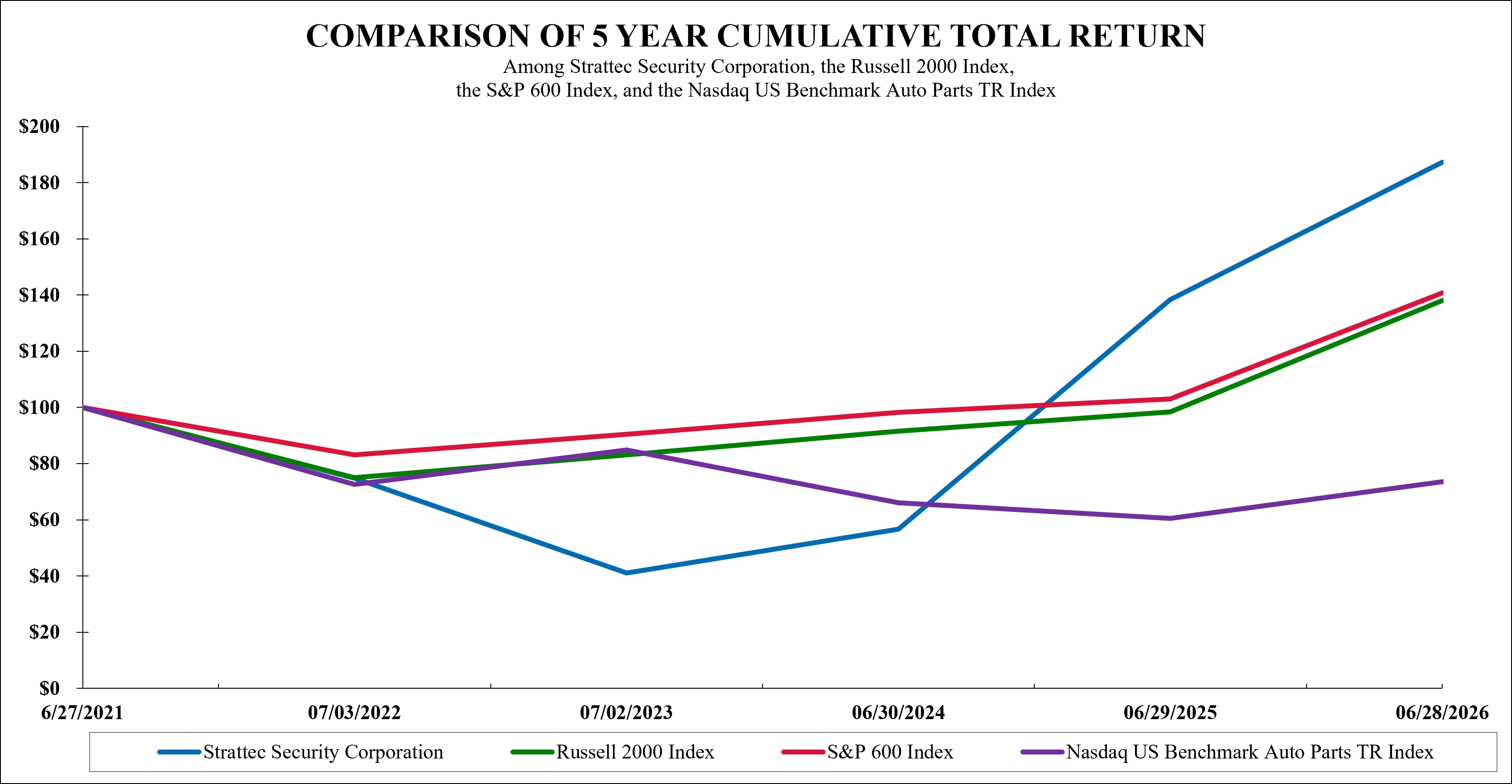
|
|
|
|
|
|
|
|
|
|
|
|
|
|
|
|
|
|
|
|
|
|
|
|
|
|
|
6/27/2021 |
|
|
07/03/2022 |
|
|
07/02/2023 |
|
|
06/30/2024 |
|
|
06/29/2025 |
|
|
06/28/2026 |
|
Strattec Security Corporation |
|
$ |
100.00 |
|
|
$ |
74.81 |
|
|
$ |
41.12 |
|
|
$ |
56.68 |
|
|
$ |
138.34 |
|
|
$ |
187.35 |
|
Russell 2000 Index |
|
$ |
100.00 |
|
|
$ |
74.93 |
|
|
$ |
83.18 |
|
|
$ |
91.55 |
|
|
$ |
98.41 |
|
|
$ |
138.07 |
|
S&P 600 Index |
|
$ |
100.00 |
|
|
$ |
83.17 |
|
|
$ |
90.44 |
|
|
$ |
98.26 |
|
|
$ |
102.96 |
|
|
$ |
140.71 |
|
Nasdaq US Benchmark Auto Parts TR Index |
|
$ |
100.00 |
|
|
$ |
72.52 |
|
|
$ |
84.94 |
|
|
$ |
66.07 |
|
|
$ |
60.48 |
|
|
$ |
73.57 |
|
ITEM 7. MANAGEMENT’S DISCUSSION AND ANALYSIS OF FINANCIAL CONDITION AND RESULTS OF OPERATIONS
The following Management's Discussion and Analysis should be read in conjunction with the accompanying audited consolidated financial statements and notes.
Business Overview
Strattec is a global automotive access company that designs and delivers safe, secure, and highly engineered access solutions for the automotive and mobility industries. Built on generations of access and security engineering expertise, Strattec partners closely with OEMs to create differentiated, system‑level access experiences for end consumers. Strattec’s portfolio spans the access journey from Permission, enabling secure vehicle entry through advanced mechanical and electronic systems; to Motion, delivering effortless, reliable powered access that enhances everyday usability; and through to Hold, providing precision‑engineered latching solutions that give drivers confidence through proven strength, safety, and durability trusted by OEMs worldwide. As access becomes increasingly intelligent, connected, and central to vehicle experience, Strattec’s strategy is to expand its market share, further diversify its customers and geographic reach while becoming the most trusted access partner to drive long‑term growth across global automotive and mobility markets. While the Company serves major automotive OEMs globally, the majority of sales are to the three largest automobile original equipment manufacturers in North America.
Current Business Update
Our strategic priority is to execute on a business transformation to strengthen the Company’s profitability and deliver sustainable sales growth. We expect to improve our business with upgraded systems and processes, modernization of our support functions and focus on productivity and efficiencies in our manufacturing operations. We believe this will result in an optimized cost structure and consistent cash generation through improved working capital velocity and efficient asset utilization. To drive organic growth, we will leverage our technical engineering expertise, market leading positions and strong customer relationships to generate innovative solutions and capture more content on current platforms, win new platforms with current customers, gain new customers both domestically and abroad and build opportunities in the broader transportation industry. The strength of our balance sheet also supports continued investments in process modernization, automation and new product innovation, as well as the flexibility needed to navigate through industry cycles.
Fiscal 2026 Financial Highlights
•Grew net sales 3% to $579.4 million driven by pricing and volume increases
•Expanded gross margin 150 basis points to 16.5%
•Delivered a 10% increase in net income to $20.6 million, or $5.00 per diluted share
•Generated $46.3 million of cash flow from operations driven by cash earnings and working capital management
•Returned $7.4 million of capital to shareholders through the repurchase of over 2% of our outstanding common stock
Business Transformation
During fiscal 2026, we continued executing on our multi-year business transformation. We made significant progress on organizational restructuring actions, operational improvements and investments in business processes and technology. We reduced total headcount by approximately 7% during the year while maintaining support for customer programs and key growth initiatives. Operationally, we continued implementing initiatives designed to improve efficiency and cost competitiveness, including manufacturing automation, freight optimization and supply chain resiliency projects. These efforts contributed to improved gross profit margin despite foreign exchange headwinds and fluctuating customer production schedules. We also advanced several foundational process and technology initiatives intended to strengthen decision-making, improve data visibility, and increase organizational effectiveness.
Commercially, we continued efforts to strengthen customer engagement, improve quoting and program management processes, refine our product portfolio and pursue opportunities to win new business from both existing and prospective customers. The automotive industry is characterized by long product development and customer sourcing cycles. New vehicle programs are typically awarded several years before the start of production, requiring suppliers to invest significant engineering, validation, tooling and program management resources well in advance of realizing sales. Customer relationships are often developed over an extended period, and it may take five to seven years or longer to establish new OEM relationships, demonstrate technical capabilities, earn customer trust and secure meaningful production awards. As a result, we are actively working to be included on vehicle platforms scheduled for production in model years 2030 and beyond. We are also working to expand our reach to a broader customer set than we have addressed historically. Our strategic initiatives are aimed at building a more predictable business that can generate consistent cash flow across industry cycles.
We believe these transformational initiatives, combined with ongoing investments in organizational capabilities, will better position the Company to respond in a changing automotive market.
Capital Allocation
Over the past two years we have driven significant cash flow from operations which has resulted in the repayment of all existing debt and continued strengthening of our balance sheet. We are committed to a disciplined capital allocation approach, designed to maximize long-term shareholder value while maintaining financial flexibility through industry cycles. Our first priority is to maintain a strong balance sheet and sufficient liquidity to support working capital requirements and capital expenditures, and allow us to navigate potential market volatility. Given the cyclical nature of the automotive industry and ongoing macroeconomic uncertainty, we believe maintaining a strong balance sheet enhances our ability to invest through economic cycles and respond to changing customer and market conditions. Our second priority is investing in the business to support long-term growth and operational improvement. These investments include customer program launches, product development, manufacturing automation, cost reduction initiatives, information technology investments, and other strategic initiatives intended to improve our competitiveness and margins. Third, we evaluate opportunities to return excess capital to shareholders. Subject to market conditions and investment opportunities we may repurchase shares on an opportunistic basis and to offset dilution associated with equity compensation programs. We also allocate capital to pursue strategic acquisition opportunities that enhance our capabilities, expand customer relationships, increase scale, improve margins, or otherwise support our long-term strategic objectives.
Market & Macro Environment
The North American automotive market continues to experience uncertainty driven by evolving trade policies, foreign exchange fluctuations, changing vehicle affordability dynamics, shifting OEM production schedules and emerging Chinese OEMs. Industry production levels remained below historical peak levels during fiscal 2026, and third-party forecasts indicate a modest (2% to 3%) decline in North American light vehicle production in fiscal 2027, while our primary customers are expected to decline 5% to 6% over the next year. Recent production forecasts have been impacted by tariff-related uncertainty, consumer demand trends, and a reduced number of scheduled vehicle launches by certain OEMs. Several of our largest customers, including Ford, General Motors, and Stellantis, continue to operate in a highly competitive environment characterized by declining market share positions, ongoing electrification strategy adjustments, and efforts to optimize vehicle inventories and production schedules. Industry participants remain focused on balancing production with retail demand following the inventory rebuilding experienced after the COVID-19 supply disruptions.
The global trade environment also remains dynamic. During fiscal 2026, the United States implemented and modified tariffs on certain imported goods, while other countries introduced reciprocal measures and trade restrictions. In addition, the ongoing review of the United States‑Mexico‑Canada Agreement ("USMCA") and potential future changes to regional content requirements, rules of origin, and tariff treatment have contributed to uncertainty across the North American automotive supply chain. These developments have required us to evaluate sourcing strategies, localization opportunities, and supply chain resiliency initiatives.
Foreign currency movements, particularly fluctuations in the Mexican peso relative to the U.S. dollar, remain an important factor affecting our operating results. Because a significant portion of the Company's manufacturing operations are located in Mexico, peso appreciation increases labor and manufacturing costs when translated into U.S. dollars. During fiscal 2026, changes in foreign exchange rates affected both operating costs and the mark-to-market valuation of the Company's foreign currency hedging program. The Company continues to utilize forward currency contracts to reduce a portion of its exposure to Mexican peso fluctuations.
While macroeconomic uncertainty, fluctuating OEM production volumes, tariffs, and foreign exchange volatility remain challenges, we believe the actions taken during fiscal 2026 have improved profitability and enhanced cash generation. As we enter fiscal 2027, we remain focused on continuing to advance our strategic priorities, executing the business transformation, strengthening operational performance, and delivering long-term value for shareholders.
Analysis of Results of Operations
The following discussion is a comparison between fiscal 2026 and fiscal 2025 results. For a discussion of our results of operations comparing fiscal 2025 to fiscal 2024, refer to Item 7 of Part II, “Management’s Discussion and Analysis of Financial Condition and Results of Operations” in our Annual Report on Form 10-K for the fiscal year ended June 29, 2025, which was filed with the SEC on August 25, 2025 and is available on our website.
Year ended June 28, 2026 (fiscal 2026) compared with the year ended June 29, 2025 (fiscal 2025)
The Company's consolidated results of operations for the years ended June 28, 2026 and June 29, 2025 were as follows (in thousands):
|
|
|
|
|
|
|
|
|
|
|
|
|
|
|
|
|
|
|
Years Ended |
|
|
Change |
|
|
|
June 28, 2026 |
|
|
June 29, 2025 |
|
|
$ |
|
|
% |
|
Net sales |
|
$ |
579,392 |
|
|
$ |
565,066 |
|
|
$ |
14,326 |
|
|
|
3 |
% |
Direct material costs |
|
|
318,628 |
|
|
|
315,320 |
|
|
|
3,308 |
|
|
|
1 |
% |
Labor and overhead costs |
|
|
165,399 |
|
|
|
165,169 |
|
|
|
230 |
|
|
|
0 |
% |
Cost of goods sold |
|
|
484,027 |
|
|
|
480,489 |
|
|
|
3,538 |
|
|
|
1 |
% |
Gross profit |
|
|
95,365 |
|
|
|
84,577 |
|
|
|
10,788 |
|
|
|
13 |
% |
Gross margin |
|
|
16.5 |
% |
|
|
15.0 |
% |
|
|
|
|
|
150 |
bp |
Selling, administrative and engineering expenses |
|
|
68,842 |
|
|
|
61,793 |
|
|
|
7,049 |
|
|
|
11 |
% |
Income from operations |
|
|
26,523 |
|
|
|
22,784 |
|
|
|
3,739 |
|
|
|
16 |
% |
Operating margin |
|
|
4.6 |
% |
|
|
4.0 |
% |
|
|
|
|
|
60 |
bp |
Interest income |
|
|
3,500 |
|
|
|
2,039 |
|
|
|
1,461 |
|
|
|
72 |
% |
Interest expense |
|
|
(359 |
) |
|
|
(1,007 |
) |
|
|
648 |
|
|
|
-64 |
% |
Other income, net |
|
|
3,298 |
|
|
|
820 |
|
|
|
2,478 |
|
|
|
302 |
% |
Income before income taxes and non-controlling interest |
|
|
32,962 |
|
|
|
24,636 |
|
|
|
8,326 |
|
|
|
34 |
% |
Income tax expense |
|
|
11,339 |
|
|
|
5,717 |
|
|
|
5,622 |
|
|
|
98 |
% |
Net income |
|
|
21,623 |
|
|
|
18,919 |
|
|
|
2,704 |
|
|
|
14 |
% |
Net income attributable to non-controlling interest |
|
|
1,025 |
|
|
|
234 |
|
|
|
791 |
|
|
|
338 |
% |
Net income attributable to Strattec |
|
$ |
20,598 |
|
|
$ |
18,685 |
|
|
$ |
1,913 |
|
|
|
10 |
% |
|
|
|
|
|
|
|
|
|
|
|
|
|
Earnings per share attributable to Strattec: |
|
|
|
|
|
|
|
|
|
|
|
|
Basic |
|
$ |
5.07 |
|
|
$ |
4.64 |
|
|
$ |
0.43 |
|
|
|
9 |
% |
Diluted |
|
$ |
5.00 |
|
|
$ |
4.58 |
|
|
$ |
0.42 |
|
|
|
9 |
% |
Net sales in fiscal 2026 totaled $579.4 million, an increase of $14.3 million, or 3%, compared with fiscal 2025 net sales of $565.1 million. The year-over-year increase was driven by $11.0 million of pricing, including $2.6 million of U.S. tariff surcharges and price increases, and $3.3 million of additional volume. Sales volumes reflected a $9.5 million increase on existing platforms and $3.3 million of net new program launches, which were partially offset by $9.5 million in reduced sales associated with customer cancelled electric vehicle ("EV") programs compared to the prior‑year.
Material costs increased $3.3 million primarily due to higher sales volumes, while labor and overhead costs increased $0.2 million. Increased conversion costs were due to higher sales volumes and a $6.5 million headwind from changes in foreign currency exchange rates. These increases were partially offset by $5.4 million in savings from previously completed restructuring actions and $1.7 million lower provisions for annual bonuses.
Gross profit was $95.4 million in fiscal 2026, compared with $84.5 million in the comparable prior-year period. Despite unfavorable changes in foreign currency exchange rates, gross margin improved year-over-year from 15.0% to 16.5%, a 150 basis point improvement, reflecting our focused efforts to manage our cost structure, incremental production volumes and pricing actions.
Selling, administrative, and engineering expenses were 11.9% of sales in fiscal 2026, compared with 10.9% in the prior-year period. Total Selling, administrative, and engineering expenses were $68.8 million in fiscal 2026, an increase of $7.0 million year-over-year. The increase in costs reflects $3.3 million associated with investments in additional talent, $3.3 million of incremental business transformation costs and $1.3 million of incremental restructuring and voluntary retirement costs related to efforts to improve our cost structure. These increases were partially offset by reduced executive transition costs of $1.4 million and $1.2 million of lower provisions for annual bonuses.
Interest income increased $1.5 million due to increased levels of cash and cash equivalents, which are invested in overnight money market funds, while interest expense decreased $0.6 million, the result of debt repayments.
Other income, net increased from $0.8 million in fiscal 2025 to $3.3 million in fiscal 2026. The increase in Other income, net was primarily due to $4.9 million realized gains on peso forward contracts, partially offset by $1.6 million foreign currency transaction losses and $0.8 million non-service pension and postemployment costs.
The effective income tax rate was 34.4% and 23.2% for fiscal 2026 and 2025, respectively. The effective rate for both periods differs from the statutory rate because of the foreign rate differential, state income taxes, research and development tax credits, limitations on the utilization of tax credits and non-deductible items. Additionally, the fiscal 2026 effective tax rate was impacted by a $1.0 million increase to valuation allowances and a $2.9 million increase to reserves for uncertain tax positions. See Note 6, “Income Taxes,” for additional information.
Fiscal 2026 net income attributable to Strattec was $20.6 million, a 10% increase compared with $18.7 million in fiscal 2025. Incremental production volumes, coupled with pricing and restructuring actions drove improved profitability, despite headwinds from changes in foreign currency exchange rates and continued investments in the business. Earnings per diluted share were $5.00 in fiscal 2026, compared with $4.58 in the prior year.
Liquidity and Capital Resources
At June 28, 2026, we had $108.2 million of cash and cash equivalents, of which $3.8 million was held by our foreign subsidiaries. The following table summarizes our cash flows provided by (used in) operating, investing and financing activities (in millions):
|
|
|
|
|
|
|
|
|
|
|
|
|
|
|
Years Ended |
|
|
|
June 28, 2026 |
|
|
June 29, 2025 |
|
|
June 30, 2024 |
|
Cash flows from: |
|
|
|
|
|
|
|
|
|
Operating activities |
|
$ |
46.3 |
|
|
$ |
71.7 |
|
|
$ |
12.3 |
|
Investing activities |
|
|
(5.4 |
) |
|
|
(7.2 |
) |
|
|
(7.8 |
) |
Financing activities |
|
|
(16.9 |
) |
|
|
(4.9 |
) |
|
|
- |
|
Effect of exchange rate changes on cash |
|
|
(0.3 |
) |
|
|
(0.4 |
) |
|
|
0.3 |
|
Net increase in cash and cash equivalents |
|
$ |
23.7 |
|
|
$ |
59.2 |
|
|
$ |
4.8 |
|
Fiscal 2026 cash flow from operations increased our balance sheet cash position, allowed us to repay all outstanding bank debt, repurchase common stock and continue to invest in the business. Cash flow from operations was $46.3 million compared with $71.7 million in the prior year. Current year cash from operations reflects improved cash earnings, while the prior year benefited from a significant reduction in primary working capital and the recovery of pre-production costs. Net cash used in investing activities was $5.4 million during fiscal 2026 compared with $7.2 million in the prior-year period. Capital expenditures to support new product programs and the upgrade and replacement of existing equipment were $7.3 million which was partially offset by $1.9 million of proceeds from the sale of property, plant and equipment. Current year cash used in financing activities resulted from the repayment of $8.0 million under our joint venture revolving credit agreement, $7.4 million repurchases of our common stock and the payment of $1.4 million for taxes withheld for the vesting of share-based awards.
Primary Working Capital Management
We use primary working capital as a percentage of sales (PWC %) as a key metric of working capital management. We define this metric as the sum of net accounts receivable and net inventory less accounts payable, divided by the past three months sales annualized. The following table shows a comparison of primary working capital (dollars in millions):
|
|
|
|
|
|
|
|
|
|
|
|
|
|
|
|
|
June 28, 2026 |
|
|
PWC % |
|
|
June 29, 2025 |
|
|
PWC % |
|
Accounts receivable, net |
$ |
99 |
|
|
|
16 |
% |
|
$ |
102 |
|
|
|
17 |
% |
Inventory, net |
|
64 |
|
|
|
11 |
% |
|
|
65 |
|
|
|
11 |
% |
Accounts payable |
|
(55 |
) |
|
|
(9 |
%) |
|
|
(66 |
) |
|
|
(11 |
%) |
Primary working capital |
$ |
108 |
|
|
|
18 |
% |
|
$ |
101 |
|
|
|
17 |
% |
Cash Requirements and Contractual Obligations
Future Capital Expenditures
We anticipate capital expenditures will be approximately $12.0 million in fiscal 2027 in support of requirements for new product programs and the upgrade and replacement of existing equipment.
Stock Repurchase Program
On May 28, 2026, the Board of Directors authorized a new share repurchase program under which we may repurchase up to $40.0
million of its outstanding common stock. The authorization has no fixed expiration date and does not obligate us to acquire any specific amount of common stock. During the fourth quarter of fiscal 2026 and prior to termination of our previous repurchase authorization, we repurchased 110,269 shares of common stock for $7.4 million. As of June 28, 2026, no shares had been repurchased under the new authorization and the full $40.0 million remained available for repurchase. Repurchases under the program, if any, are expected to be funded through cash generated from operations and existing cash balances.
Credit Facilities
We have a revolving credit facility with BMO Harris Bank N.A., which provides for a $40 million revolving line of credit maturing October 2028. The Company's joint venture also has a revolving credit agreement with BMO Harris Bank N.A., which provides for a $10 million asset-based revolving line of credit, subject to a borrowing base, maturing October 2028.
There were no outstanding borrowings and no interest due on either facility as of June 28, 2026. The repayment of any balance drawn on these facilities and the related interest payment obligations are expected to be funded by cash flow from operations and current cash balances. For further information related to our credit facilities, see Note 3, "Credit Facilities," for additional information.
Income Taxes
We may be required to make cash outlays related to our unrecognized tax benefits, including interest and penalties. As of June 28, 2026, we had unrecognized tax benefits, including interest and penalties, of $4.7 million. However, due to the uncertainty of the timing of future cash flows associated with our unrecognized tax benefits, we are unable to make reasonably reliable estimates of the period of cash settlement, if any, with the respective taxing authorities. For further information related to our unrecognized tax benefits, see Note 6, "Income Taxes," for additional information.
Critical Accounting Estimates
We prepare our consolidated financial statements in conformity with U.S. GAAP. This requires management to make estimates and assumptions that affect reported amounts and related disclosures. Actual results could differ from those estimates. The following estimates are considered by management to be the most critical in understanding judgments involved in the preparation of our consolidated financial statements and uncertainties that could impact our results of operations, financial position and cash flow.
Revenue Recognition
We enter into contracts with our customers generally at the beginning of a vehicle's lifecycle. Typically, these contracts do not provide for a specified quantity of products, but once entered into, we are often expected to fulfill our customers' purchasing requirements for the life of the vehicle. These contracts may be terminated by our customers at any time. Historically, terminations of these contracts have been infrequent.
Throughout a vehicle's lifecycle, we receive purchase orders from our customers, which provide the commercial terms for a sale transaction. Revenue is typically recognized at a point in time based on the transaction price and the quantity of parts shipped to the customer. Discrete price adjustments may occur during the vehicle production period in order for us to remain competitive with market prices or based on changes in product specifications or based on changes in significant input costs for the products. In the event the Company concludes that a portion of the revenue for a given product may vary from the purchase order, we record consideration at the most likely amount to which we expect to be entitled based on historical experience and input from customer negotiations.
Warranty
We have a warranty reserve recorded related to our exposure to warranty claims in the event our products fail to perform as expected, and we may be required to participate in the repair costs incurred by our customers for such products. The recorded warranty reserve balance involves judgment and estimates. Our reserve estimate is based on an analysis of historical warranty data as well as current trends and information. Actual warranty costs might differ from estimates due to the level of actual claims varying from our historical claims experience and estimates and final negotiations and settlements reached with our customers. Therefore, future actual claims experience could result in changes in our estimates of the required reserve. Sensitivity of potential warranty claims is dependent on the respective customer platform, volumes, production years and product content.
Income Tax
Judgment is required to determine the annual effective income tax rate, deferred tax assets and liabilities, reserves for unrecognized tax benefits and any valuation allowances recorded against net deferred tax assets. Our effective income tax rate is based on annual income, statutory tax rates, tax planning opportunities available in the various jurisdictions in which we operate and other adjustments. Tax regulations require items to be included in our tax returns at different times than these same items are reflected in our consolidated financial statements.
As a result, these differences and the interplay in tax laws between jurisdictions may cause our estimates of income tax liabilities to differ from actual payments or assessments. Some of these differences are permanent, such as expenses that are not tax deductible, while others are temporary differences, such as amortization and depreciation expenses. Temporary differences create deferred tax assets and liabilities, which are measured using enacted tax rates expected to apply to taxable income in the years in which those temporary differences are expected to be recovered or settled. We establish valuation allowances for our deferred tax assets when the amount of expected future taxable income is not large enough to utilize the entire deduction or credit. Relevant factors in determining the realizability of deferred tax assets include future taxable income, the expected timing of the reversal of temporary differences, tax planning strategies and the expiration dates of the various tax attributes.
While we have support for the positions taken on tax returns, taxing authorities may assert different interpretations of laws and facts and may challenge cross-jurisdictional transactions. We assess our income tax positions and record tax liabilities for all years subject to examination based upon management’s evaluation of the facts and circumstances and information available at the reporting dates. For those tax positions which do not meet the more-likely-than-not threshold regarding the ultimate realization of the related tax benefit, no tax benefit has been recorded in the financial statements.
Post-employment Benefits
We have post-employment liabilities, including a supplemental executive retirement plan, termination indemnity plans and seniority premium obligations that are developed from actuarial valuations. These valuations include key assumptions regarding discount rates, expected return on plan assets and rate of compensation increases. We consider current market conditions in selecting these assumptions. While the Company believes that these assumptions are appropriate, significant differences in actual experience or significant changes in assumptions may materially affect the Company's liability or future expense.
ITEM 7A. QUANTITATIVE AND QUALITATIVE DISCLOSURES ABOUT MARKET RISK
We are exposed to market risks in the normal course of business, primarily from changes in interest rates, foreign currency exchange rates, and prices of certain production materials. The disclosures below relate to market risk sensitive instruments and other exposures we believe are material to our business. We do not enter into derivative instruments for trading or speculative purposes.
Interest Rate Risk
We are exposed to interest rate risk if we borrow under our revolving credit facilities. There were no outstanding borrowings under the revolving credit facility at June 28, 2026. Refer to Note 3, “Debt,” in the Notes to Consolidated Financial Statements for more information on interest rates.
Commodity Risk
We are exposed to market risk from changes in the prices of production materials, principally steel, zinc, resins and plastics, which are significant inputs to our products. Our exposure to these costs is managed primarily through commercial arrangements rather than financial instruments. For certain commodities, the Company has entered into purchase or sales agreements under which pricing is adjusted by reference to published market indices, which serves to align a portion of our raw material cost movements with corresponding adjustments in the prices charged to, or paid by, customers and suppliers and thereby reduces our net exposure for those commodities. Index-based adjustments and customer recoveries are subject to timing lags, periodic reset provisions, and negotiation, and a portion of our commodity purchases is not covered by index-based or pass-through arrangements. As a result, there can be no assurance that we will recover all increases in production material costs from customers or recover them in the period in which the costs are incurred.
Foreign Currency Risk
We have international operations, including significant operations in Mexico, which expose us to foreign currency exchange rate risk. A portion of our manufacturing costs is denominated in Mexican pesos, and changes in the U.S. dollar/Mexican peso exchange rate affect our results of operations and cash flows. A hypothetical 10% strengthening or weakening of the U.S. dollar relative to the Mexican peso would have affected fiscal 2026 cost of goods sold by approximately $7.0 million. This sensitivity analysis is based on peso-denominated operating costs incurred during fiscal 2026 and does not reflect the potential impact of pricing actions, productivity initiatives, customer recoveries, or other mitigating actions. We also use foreign currency forward contracts to mitigate a portion of this exposure, and therefore actual results may differ from the sensitivity analysis presented above.
We also translate the assets and liabilities of foreign operations where the U.S. dollar is not the functional currency at period-end exchange rates and translate expenses at average exchange rates in effect during the period. The resulting translation adjustments are recorded as a component of accumulated other comprehensive loss. Foreign currency translation adjustments were a gain of $2.7 million in fiscal 2026 and a loss of $1.2 million in fiscal 2025.
To manage a portion of our short-term foreign currency exposure, principally related to peso-denominated operating costs, we enter into Mexican peso forward contracts. These contracts are not designated as hedges for accounting purposes and are not used for trading or speculative purposes. The contracts are recorded at fair value in the consolidated balance sheets, and changes in fair value are recognized in Other income, net. At June 28, 2026 and June 29, 2025, the aggregate notional amounts of outstanding foreign currency forward contracts were $92.3 million and $32.0 million, respectively. We recognized net gains on these contracts of $4.6 million, $1.9 million, and $0.9 million in fiscal 2026, 2025, and 2024, respectively.
Separately, net foreign currency transaction gains (losses) arising from the remeasurement of monetary assets and liabilities denominated in currencies other than the functional currency were $(1.6) million, $(0.6) million and $2.2 million in fiscal 2026, 2025 and 2024, respectively.
ITEM 8. FINANCIAL STATEMENTS AND SUPPLEMENTARY DATA
REPORT OF INDEPENDENT REGISTERED PUBLIC ACCOUNTING FIRM
To the shareholders and the Board of Directors of Strattec Security Corporation
Opinion on the Financial Statements
We have audited the accompanying consolidated balance sheets of Strattec Security Corporation and subsidiaries (the "Company") as of June 28, 2026, and June 29, 2025, the related consolidated statements of income and comprehensive income, shareholders' equity, and cash flows, for the fiscal years ended June 28, 2026, June 29, 2025, and June 30, 2024 and the related notes and the schedule listed in the Index at Item 15 (collectively referred to as the "financial statements"). In our opinion, the financial statements present fairly, in all material respects, the financial position of the Company as of June 28, 2026 and June 29, 2025, and the results of its operations and its cash flows for the fiscal years ended June 28, 2026, June 29, 2025, and June 30, 2024 in conformity with accounting principles generally accepted in the United States of America.
We have also audited, in accordance with the standards of the Public Company Accounting Oversight Board (United States) (PCAOB), the Company's internal control over financial reporting as of June 28, 2026, based on criteria established in Internal Control — Integrated Framework (2013) issued by the Committee of Sponsoring Organizations of the Treadway Commission and our report dated August 28, 2026, expressed an unqualified opinion on the Company's internal control over financial reporting.
Basis for Opinion
These financial statements are the responsibility of the Company's management. Our responsibility is to express an opinion on the Company's financial statements based on our audits. We are a public accounting firm registered with the PCAOB and are required to be independent with respect to the Company in accordance with the U.S. federal securities laws and the applicable rules and regulations of the Securities and Exchange Commission and the PCAOB.
We conducted our audits in accordance with the standards of the PCAOB. Those standards require that we plan and perform the audit to obtain reasonable assurance about whether the financial statements are free of material misstatement, whether due to error or fraud. Our audits included performing procedures to assess the risks of material misstatement of the financial statements, whether due to error or fraud, and performing procedures that respond to those risks. Such procedures included examining, on a test basis, evidence regarding the amounts and disclosures in the financial statements. Our audits also included evaluating the accounting principles used and significant estimates made by management, as well as evaluating the overall presentation of the financial statements. We believe that our audits provide a reasonable basis for our opinion.
Critical Audit Matter
The critical audit matter communicated below is a matter arising from the current-period audit of the financial statements that was communicated or required to be communicated to the audit committee and that (1) relates to accounts or disclosures that are material to the financial statements and (2) involved our especially challenging, subjective, or complex judgments. The communication of critical audit matters does not alter in any way our opinion on the financial statements, taken as a whole, and we are not, by communicating the critical audit matter below, providing a separate opinion on the critical audit matter or on the accounts or disclosures to which it relates.
General Warranty Reserve – Refer to Note 2 to the Financial Statements
Critical Audit Matter Description
The Company records a general warranty reserve for potential exposure to warranty claims in the event its products fail to perform as expected and when it is probable that they will participate in the repair costs incurred by its customers for such products.
The general warranty reserve is estimated based on management’s analysis of historical warranty data, current trends and information, projected claims for products sold, and the terms of specific agreements. The general warranty reserve requires management to apply significant judgment to develop its estimate. Actual warranty costs may differ from management’s estimated costs as a result of, but not limited to, negotiation with customers, changes to the assumptions of repair and/or replacement costs, and repair rate. Such matters may require future adjustments to the reserve which could be material.
We identified the general warranty reserve as a critical audit matter because estimating future warranty costs requires significant judgment by management. Auditing management’s assumptions about management’s estimated future warranty costs involves a high degree of auditor judgment and an increased extent of effort to evaluate the reasonableness of management’s estimates.
How the Critical Audit Matter Was Addressed in the Audit
Our audit procedures related to the determination of the general warranty reserve included the following, among others:
- We tested the effectiveness of internal controls relating to management’s process for developing the assumptions and inputs used to estimate the general warranty reserve.
- We evaluated the methods and significant assumptions, including the frequency and average cost of warranty claims, used by management to estimate the general warranty reserve by:
o Evaluating the methodology used to determine the general warranty reserve in order to understand how key assumptions were developed.
o Testing the accuracy of the underlying data that served as the basis for the analysis, including historical failure rates and costs to repair, share rates agreed upon with the customers, and units sold.
o Testing the completeness of the general warranty reserve by conducting inquiries of operational and executive management regarding knowledge of product issues and evaluating whether they were appropriately considered in the determination of the general warranty reserve.
o Testing the mathematical accuracy of management’s calculation of the general warranty reserve.
/s/ Deloitte & Touche LLP
Milwaukee, Wisconsin
August 28, 2026
We have served as the Company's auditor since 2023.
REPORT OF INDEPENDENT REGISTERED PUBLIC ACCOUNTING FIRM
To the shareholders and the Board of Directors of Strattec Security Corporation
Opinion on Internal Control over Financial Reporting
We have audited the internal control over financial reporting of Strattec Security Corporation and subsidiaries (the "Company") as of June 28, 2026, based on criteria established in Internal Control — Integrated Framework (2013) issued by the Committee of Sponsoring Organizations of the Treadway Commission (COSO). In our opinion, the Company maintained, in all material respects, effective internal control over financial reporting as of June 28, 2026, based on criteria established in Internal Control — Integrated Framework (2013) issued by COSO.
We have also audited, in accordance with the standards of the Public Company Accounting Oversight Board (United States) (PCAOB), the consolidated financial statements as of and for the year ended June 28, 2026 of the Company and our report dated August 28, 2026 expressed an unqualified opinion on those financial statements.
Basis for Opinion
The Company's management is responsible for maintaining effective internal control over financial reporting and for its assessment of the effectiveness of internal control over financial reporting, included in the accompanying Management's Annual Report on Internal Controls over Financial Reporting. Our responsibility is to express an opinion on the Company's internal control over financial reporting based on our audit. We are a public accounting firm registered with the PCAOB and are required to be independent with respect to the Company in accordance with the U.S. federal securities laws and the applicable rules and regulations of the Securities and Exchange Commission and the PCAOB.
We conducted our audit in accordance with the standards of the PCAOB. Those standards require that we plan and perform the audit to obtain reasonable assurance about whether effective internal control over financial reporting was maintained in all material respects. Our audit included obtaining an understanding of internal control over financial reporting, assessing the risk that a material weakness exists, testing and evaluating the design and operating effectiveness of internal control based on the assessed risk, and performing such other procedures as we considered necessary in the circumstances. We believe that our audit provides a reasonable basis for our opinion.
Definition and Limitations of Internal Control over Financial Reporting
A company's internal control over financial reporting is a process designed to provide reasonable assurance regarding the reliability of financial reporting and the preparation of financial statements for external purposes in accordance with generally accepted accounting principles. A company's internal control over financial reporting includes those policies and procedures that (1) pertain to the maintenance of records that, in reasonable detail, accurately and fairly reflect the transactions and dispositions of the assets of the company; (2) provide reasonable assurance that transactions are recorded as necessary to permit preparation of financial statements in accordance with generally accepted accounting principles, and that receipts and expenditures of the company are being made only in accordance with authorizations of management and directors of the company; and (3) provide reasonable assurance regarding prevention or timely detection of unauthorized acquisition, use, or disposition of the company's assets that could have a material effect on the financial statements.
Because of its inherent limitations, internal control over financial reporting may not prevent or detect misstatements. Also, projections of any evaluation of effectiveness to future periods are subject to the risk that controls may become inadequate because of changes in conditions, or that the degree of compliance with the policies or procedures may deteriorate.
/s/ Deloitte & Touche LLP
Milwaukee, Wisconsin
August 28, 2026
STRATTEC SECURITY CORPORATION AND SUBSIDIARIES
CONSOLIDATED STATEMENTS OF INCOME
(in thousands, except per share amounts)
|
|
|
|
|
|
|
|
|
|
|
|
|
|
|
Years Ended |
|
|
|
June 28, 2026 |
|
|
June 29, 2025 |
|
|
June 30, 2024 |
|
Net sales |
|
$ |
579,392 |
|
|
$ |
565,066 |
|
|
$ |
537,766 |
|
Cost of goods sold |
|
|
484,027 |
|
|
|
480,489 |
|
|
|
472,298 |
|
Gross profit |
|
|
95,365 |
|
|
|
84,577 |
|
|
|
65,468 |
|
Selling, administrative and engineering expenses |
|
|
68,842 |
|
|
|
61,793 |
|
|
|
47,654 |
|
Income from operations |
|
|
26,523 |
|
|
|
22,784 |
|
|
|
17,814 |
|
Interest income |
|
|
3,500 |
|
|
|
2,039 |
|
|
|
572 |
|
Interest expense |
|
|
(359 |
) |
|
|
(1,007 |
) |
|
|
(900 |
) |
Other income, net |
|
|
3,298 |
|
|
|
820 |
|
|
|
2,717 |
|
Income before income taxes and non-controlling interest |
|
|
32,962 |
|
|
|
24,636 |
|
|
|
20,203 |
|
Income tax expense |
|
|
11,339 |
|
|
|
5,717 |
|
|
|
3,775 |
|
Net income |
|
|
21,623 |
|
|
|
18,919 |
|
|
|
16,428 |
|
Net income attributable to non-controlling interest |
|
|
1,025 |
|
|
|
234 |
|
|
|
115 |
|
Net income attributable to Strattec |
|
$ |
20,598 |
|
|
$ |
18,685 |
|
|
$ |
16,313 |
|
|
|
|
|
|
|
|
|
|
|
Earnings per share attributable to Strattec |
|
|
|
|
|
|
|
|
|
Basic |
|
$ |
5.07 |
|
|
$ |
4.64 |
|
|
$ |
4.10 |
|
Diluted |
|
$ |
5.00 |
|
|
$ |
4.58 |
|
|
$ |
4.07 |
|
The accompanying notes are an integral part of these Consolidated Financial Statements.
STRATTEC SECURITY CORPORATION AND SUBSIDIARIES
CONSOLIDATED STATEMENTS OF COMPREHENSIVE INCOME
(in thousands)
|
|
|
|
|
|
|
|
|
|
|
|
|
|
|
Years Ended |
|
|
|
June 28, 2026 |
|
|
June 29, 2025 |
|
|
June 30, 2024 |
|
Net income |
|
$ |
21,623 |
|
|
$ |
18,919 |
|
|
$ |
16,428 |
|
|
|
|
|
|
|
|
|
|
|
Other comprehensive income (loss), net of tax: |
|
|
|
|
|
|
|
|
|
Currency translation adjustments |
|
|
2,651 |
|
|
|
(1,170 |
) |
|
|
(2,794 |
) |
Pension and postretirement plans |
|
|
306 |
|
|
|
281 |
|
|
|
193 |
|
Total other comprehensive income (loss), net of tax |
|
|
2,957 |
|
|
|
(889 |
) |
|
|
(2,601 |
) |
Comprehensive income |
|
|
24,580 |
|
|
|
18,030 |
|
|
|
13,827 |
|
Comprehensive income (loss) attributable to non-controlling interest |
|
|
2,012 |
|
|
|
(231 |
) |
|
|
(991 |
) |
Comprehensive income attributable to Strattec |
|
$ |
22,568 |
|
|
$ |
18,261 |
|
|
$ |
14,818 |
|
The accompanying notes are an integral part of these Consolidated Financial Statements.
STRATTEC SECURITY CORPORATION AND SUBSIDIARIES
CONSOLIDATED BALANCE SHEETS
(in thousands, except share amounts and per share amounts)
|
|
|
|
|
|
|
|
|
|
|
June 28, 2026 |
|
|
June 29, 2025 |
|
ASSETS |
|
|
|
|
|
|
Current Assets: |
|
|
|
|
|
|
Cash and cash equivalents |
|
$ |
108,243 |
|
|
$ |
84,579 |
|
Receivables, net |
|
|
99,109 |
|
|
|
102,061 |
|
Inventories: |
|
|
|
|
|
|
Finished products |
|
|
11,775 |
|
|
|
12,398 |
|
Work in process |
|
|
11,905 |
|
|
|
11,303 |
|
Purchased materials |
|
|
40,630 |
|
|
|
41,000 |
|
Inventories, net |
|
|
64,310 |
|
|
|
64,701 |
|
Pre-production costs |
|
|
6,489 |
|
|
|
8,657 |
|
Value added tax recoverable |
|
|
10,069 |
|
|
|
19,389 |
|
Income tax recoverable |
|
|
2,243 |
|
|
|
2,465 |
|
Other current assets |
|
|
5,810 |
|
|
|
8,211 |
|
Total current assets |
|
|
296,273 |
|
|
|
290,063 |
|
Noncurrent Assets: |
|
|
|
|
|
|
Property, plant and equipment: |
|
|
|
|
|
|
Land and improvements |
|
|
6,915 |
|
|
|
6,582 |
|
Buildings and improvements |
|
|
42,969 |
|
|
|
39,821 |
|
Machinery and equipment |
|
|
225,548 |
|
|
|
236,545 |
|
Total property, plant and equipment |
|
|
275,432 |
|
|
|
282,948 |
|
Less: accumulated depreciation |
|
|
205,587 |
|
|
|
205,538 |
|
Property, plant and equipment, net |
|
|
69,845 |
|
|
|
77,410 |
|
Deferred income taxes |
|
|
16,080 |
|
|
|
19,531 |
|
Other noncurrent assets |
|
|
5,281 |
|
|
|
4,450 |
|
Total Assets |
|
$ |
387,479 |
|
|
$ |
391,454 |
|
LIABILITIES AND SHAREHOLDERS' EQUITY |
|
|
|
|
|
|
Current Liabilities: |
|
|
|
|
|
|
Accounts payable |
|
$ |
54,973 |
|
|
$ |
65,824 |
|
Accrued payroll and benefits |
|
|
20,773 |
|
|
|
22,956 |
|
Value added tax payable |
|
|
7,429 |
|
|
|
11,933 |
|
Income tax payable |
|
|
197 |
|
|
|
88 |
|
Warranty reserve |
|
|
6,673 |
|
|
|
8,900 |
|
Other current liabilities |
|
|
12,186 |
|
|
|
9,649 |
|
Total current liabilities |
|
|
102,231 |
|
|
|
119,350 |
|
Noncurrent Liabilities: |
|
|
|
|
|
|
Borrowings under credit facilities |
|
|
- |
|
|
|
8,000 |
|
Post-employment benefits |
|
|
13,350 |
|
|
|
13,325 |
|
Other noncurrent liabilities |
|
|
6,401 |
|
|
|
4,348 |
|
Total Liabilities |
|
$ |
121,982 |
|
|
$ |
145,023 |
|
Shareholders' Equity: |
|
|
|
|
|
|
Common stock, authorized 18,000,000 shares, $.01 par value, 7,704,994
issued shares at June 28, 2026 and 7,635,883 issued shares at June 29, 2025 |
|
$ |
77 |
|
|
$ |
76 |
|
Capital in excess of par value |
|
|
107,138 |
|
|
|
103,784 |
|
Retained earnings |
|
|
289,895 |
|
|
|
269,297 |
|
Accumulated other comprehensive loss |
|
|
(14,143 |
) |
|
|
(16,113 |
) |
Less: treasury stock, at cost (3,727,322 shares at June 28, 2026 and
3,596,549 shares at June 29, 2025) |
|
|
(144,321 |
) |
|
|
(135,452 |
) |
Total Strattec shareholders’ equity |
|
|
238,646 |
|
|
|
221,592 |
|
Non-controlling interest |
|
|
26,851 |
|
|
|
24,839 |
|
Total Shareholders' Equity |
|
|
265,497 |
|
|
|
246,431 |
|
Total Liabilities and Shareholders' Equity |
|
$ |
387,479 |
|
|
$ |
391,454 |
|
The accompanying notes are an integral part of these Consolidated Financial Statements.
STRATTEC SECURITY CORPORATION AND SUBSIDIARIES
CONSOLIDATED STATEMENTS OF SHAREHOLDERS’ EQUITY
(in thousands)
|
|
|
|
|
|
|
|
|
|
|
|
|
|
|
|
|
|
|
|
|
|
|
|
|
|
|
|
|
|
|
Common Stock |
|
|
Capital in Excess of Par Value |
|
|
Retained Earnings |
|
|
Accumulated Other Comprehensive Loss |
|
|
Treasury Stock |
|
|
Non-controlling interest |
|
|
Total Shareholders' Equity |
|
Balance -- July 2, 2023 |
|
$ |
75 |
|
|
$ |
100,309 |
|
|
$ |
234,299 |
|
|
$ |
(14,194 |
) |
|
$ |
(135,526 |
) |
|
$ |
26,061 |
|
|
$ |
211,024 |
|
Net income |
|
|
— |
|
|
|
— |
|
|
|
16,313 |
|
|
|
— |
|
|
|
— |
|
|
|
115 |
|
|
|
16,428 |
|
Currency translation adjustments |
|
|
— |
|
|
|
— |
|
|
|
— |
|
|
|
(1,688 |
) |
|
|
— |
|
|
|
(1,106 |
) |
|
|
(2,794 |
) |
Pension and postretirement funded status adjustment, net of tax of $59 |
|
|
— |
|
|
|
— |
|
|
|
— |
|
|
|
193 |
|
|
|
— |
|
|
|
- |
|
|
|
193 |
|
Purchase of former joint venture non-controlling interest |
|
|
— |
|
|
|
(775 |
) |
|
|
— |
|
|
|
|
|
|
— |
|
|
|
- |
|
|
|
(775 |
) |
Stock-based compensation |
|
|
— |
|
|
|
1,467 |
|
|
|
— |
|
|
|
— |
|
|
|
— |
|
|
|
- |
|
|
|
1,467 |
|
Share issuances |
|
|
1 |
|
|
|
23 |
|
|
|
— |
|
|
|
— |
|
|
|
48 |
|
|
|
- |
|
|
|
72 |
|
Balance -- June 30, 2024 |
|
$ |
76 |
|
|
$ |
101,024 |
|
|
$ |
250,612 |
|
|
$ |
(15,689 |
) |
|
$ |
(135,478 |
) |
|
$ |
25,070 |
|
|
$ |
225,615 |
|
Net income |
|
|
— |
|
|
|
— |
|
|
|
18,685 |
|
|
|
— |
|
|
|
— |
|
|
|
234 |
|
|
|
18,919 |
|
Currency translation adjustments |
|
|
— |
|
|
|
— |
|
|
|
— |
|
|
|
(705 |
) |
|
|
— |
|
|
|
(465 |
) |
|
|
(1,170 |
) |
Pension and postretirement funded status adjustment, net of tax of $82 |
|
|
— |
|
|
|
— |
|
|
|
— |
|
|
|
281 |
|
|
|
— |
|
|
|
— |
|
|
|
281 |
|
Stock-based compensation |
|
|
— |
|
|
|
2,725 |
|
|
|
— |
|
|
|
— |
|
|
|
— |
|
|
|
— |
|
|
|
2,725 |
|
Share issuances |
|
|
— |
|
|
|
35 |
|
|
|
— |
|
|
|
— |
|
|
|
26 |
|
|
|
— |
|
|
|
61 |
|
Balance -- June 29, 2025 |
|
$ |
76 |
|
|
$ |
103,784 |
|
|
$ |
269,297 |
|
|
$ |
(16,113 |
) |
|
$ |
(135,452 |
) |
|
$ |
24,839 |
|
|
$ |
246,431 |
|
Net income |
|
|
— |
|
|
|
— |
|
|
|
20,598 |
|
|
|
— |
|
|
|
— |
|
|
|
1,025 |
|
|
|
21,623 |
|
Currency translation adjustments |
|
|
— |
|
|
|
— |
|
|
|
— |
|
|
|
1,664 |
|
|
|
— |
|
|
|
987 |
|
|
|
2,651 |
|
Pension and postretirement funded status adjustment, net of tax of $89 |
|
|
— |
|
|
|
— |
|
|
|
— |
|
|
|
306 |
|
|
|
— |
|
|
|
— |
|
|
|
306 |
|
Stock-based compensation |
|
|
— |
|
|
|
3,305 |
|
|
|
— |
|
|
|
— |
|
|
|
— |
|
|
|
— |
|
|
|
3,305 |
|
Shares withheld for taxes on stock-based awards |
|
|
— |
|
|
|
— |
|
|
|
— |
|
|
|
— |
|
|
|
(1,442 |
) |
|
|
— |
|
|
|
(1,442 |
) |
Share issuances |
|
|
1 |
|
|
|
49 |
|
|
|
— |
|
|
|
— |
|
|
|
14 |
|
|
|
— |
|
|
|
64 |
|
Repurchases of common stock under share repurchase program |
|
|
— |
|
|
|
— |
|
|
|
— |
|
|
|
— |
|
|
|
(7,441 |
) |
|
|
— |
|
|
|
(7,441 |
) |
Balance -- June 28, 2026 |
|
$ |
77 |
|
|
$ |
107,138 |
|
|
$ |
289,895 |
|
|
$ |
(14,143 |
) |
|
$ |
(144,321 |
) |
|
$ |
26,851 |
|
|
$ |
265,497 |
|
The accompanying notes are an integral part of these Consolidated Financial Statements.
STRATTEC SECURITY CORPORATION AND SUBSIDIARIES
CONSOLIDATED STATEMENTS OF CASH FLOWS
(in thousands)
|
|
|
|
|
|
|
|
|
|
|
|
|
|
|
Years Ended |
|
|
|
June 28, 2026 |
|
|
June 29, 2025 |
|
|
June 30, 2024 |
|
OPERATING ACTIVITIES: |
|
|
|
|
|
|
|
|
|
Net income |
|
$ |
21,623 |
|
|
$ |
18,919 |
|
|
$ |
16,428 |
|
Adjustments to reconcile net income to net cash provided by operating
activities: |
|
|
|
|
|
|
|
|
|
Depreciation |
|
|
15,085 |
|
|
|
14,764 |
|
|
|
16,547 |
|
Foreign currency transaction loss (gain) |
|
|
1,560 |
|
|
|
591 |
|
|
|
(2,153 |
) |
Deferred income taxes |
|
|
3,563 |
|
|
|
(1,890 |
) |
|
|
(4,711 |
) |
Stock-based compensation expense |
|
|
3,305 |
|
|
|
2,725 |
|
|
|
1,467 |
|
Unrealized loss (gain) on peso contracts |
|
|
349 |
|
|
|
(2,314 |
) |
|
|
— |
|
Other, net |
|
|
345 |
|
|
|
1,348 |
|
|
|
919 |
|
Change in operating assets and liabilities: |
|
|
|
|
|
|
|
|
|
Receivables |
|
|
2,992 |
|
|
|
(3,085 |
) |
|
|
(9,356 |
) |
Inventories |
|
|
391 |
|
|
|
16,948 |
|
|
|
(4,052 |
) |
Prepaids and other assets |
|
|
9,466 |
|
|
|
12,027 |
|
|
|
(13,562 |
) |
Accounts payable |
|
|
(10,431 |
) |
|
|
10,674 |
|
|
|
(3,016 |
) |
Accrued liabilities |
|
|
(1,944 |
) |
|
|
970 |
|
|
|
13,754 |
|
Net cash provided by operating activities |
|
|
46,304 |
|
|
|
71,677 |
|
|
|
12,265 |
|
INVESTING ACTIVITIES: |
|
|
|
|
|
|
|
|
|
Proceeds from sale of interest in joint ventures |
|
|
— |
|
|
|
— |
|
|
|
2,000 |
|
Purchase of property, plant and equipment |
|
|
(7,328 |
) |
|
|
(7,156 |
) |
|
|
(9,788 |
) |
Proceeds from sale of property, plant and equipment |
|
|
1,930 |
|
|
|
— |
|
|
|
— |
|
Net cash used in investing activities |
|
|
(5,398 |
) |
|
|
(7,156 |
) |
|
|
(7,788 |
) |
FINANCING ACTIVITIES: |
|
|
|
|
|
|
|
|
|
Borrowings under credit facilities |
|
|
— |
|
|
|
3,000 |
|
|
|
2,000 |
|
Repayments under credit facilities |
|
|
(8,000 |
) |
|
|
(8,000 |
) |
|
|
(2,000 |
) |
Payment for debt issuance costs |
|
|
(132 |
) |
|
|
— |
|
|
|
— |
|
Repurchases of common stock under share repurchase program |
|
|
(7,400 |
) |
|
|
— |
|
|
|
— |
|
Payment for taxes withheld from stock-based awards |
|
|
(1,442 |
) |
|
|
— |
|
|
|
— |
|
Share issuances |
|
|
64 |
|
|
|
61 |
|
|
|
72 |
|
Net cash (used in) provided by financing activities |
|
|
(16,910 |
) |
|
|
(4,939 |
) |
|
|
72 |
|
Foreign currency impact on cash |
|
|
(332 |
) |
|
|
(413 |
) |
|
|
290 |
|
NET INCREASE IN CASH AND CASH EQUIVALENTS |
|
|
23,664 |
|
|
|
59,169 |
|
|
|
4,839 |
|
|
|
|
|
|
|
|
|
|
|
CASH AND CASH EQUIVALENTS: |
|
|
|
|
|
|
|
|
|
Beginning of year |
|
|
84,579 |
|
|
|
25,410 |
|
|
|
20,571 |
|
End of year |
|
$ |
108,243 |
|
|
$ |
84,579 |
|
|
$ |
25,410 |
|
|
|
|
|
|
|
|
|
|
|
SUPPLEMENTAL DISCLOSURE OF CASH FLOW INFORMATION: |
|
|
|
|
|
|
|
|
|
Cash paid during the period for: |
|
|
|
|
|
|
|
|
|
Income taxes |
|
$ |
4,746 |
|
|
$ |
14,174 |
|
|
$ |
3,801 |
|
Interest |
|
$ |
218 |
|
|
$ |
1,007 |
|
|
$ |
888 |
|
Non-cash investing activities: |
|
|
|
|
|
|
|
|
|
Change in capital expenditures in accounts payable |
|
$ |
(79 |
) |
|
$ |
(422 |
) |
|
$ |
171 |
|
The accompanying notes are an integral part of these Consolidated Financial Statements.
STRATTEC SECURITY CORPORATION AND SUBSIDIARIES
NOTES TO CONSOLIDATED FINANCIAL STATEMENTS
NOTE 1. ORGANIZATION AND NATURE OF BUSINESS
Strattec Security Corporation (the "Company" or “Strattec”), headquartered in Milwaukee, Wisconsin, is a leading global manufacturer and provider of highly engineered advanced automotive access and security products and solutions. Products include power access solutions, locks & locksets, keys & fobs, engineered latches, vehicle start systems, door handles, and other vehicle access products. Power access solutions provide the motion control for power liftgates, sliding power doors and power tailgates. While the Company serves major automotive original equipment manufacturers (“OEMs”) globally, the majority of sales are to the three largest OEMs in North America.
NOTE 2. SUMMARY OF SIGNIFICANT ACCOUNTING POLICIES
Principles of Consolidation and Basis of Presentation
The accompanying consolidated financial statements of the Company have been prepared in accordance with United States generally accepted accounting principles (U.S. GAAP) and reflect the consolidated results of Strattec. All significant intercompany transactions and balances have been eliminated in consolidation. The Company's fiscal year ends on the Sunday nearest June 30. The years ended June 28, 2026, June 29, 2025, and June 30, 2024 are each comprised of 52 weeks.
Use of Estimates
The preparation of financial statements in conformity with U.S. GAAP requires management to make estimates and assumptions that affect the reported amounts of assets, liabilities, revenue and expenses for the periods presented. These estimates and assumptions could also affect the disclosure of contingencies. Actual results and outcomes may differ from management’s estimates and assumptions.
Recently Issued Accounting Standards
In December 2023, the Financial Accounting Standards Board (FASB) issued ASU 2023-09, Income Taxes (Topic 740): Improvements to Income Tax Disclosures. This ASU is intended to enhance the transparency and decision usefulness of income tax disclosures to provide information to better assess how an entity's operations and related tax risks and tax planning and operational opportunities affect its tax rate and prospects for future cash flows. For the Company, this ASU is effective for annual periods beginning after December 15, 2024 (fiscal 2026). The Company adopted this standard prospectively with the additional and enhanced disclosures presented in Note 6, “Income taxes.”
In November 2024, the FASB issued ASU 2024-03, Income Statement – Reporting Comprehensive Income – Expense Disaggregation Disclosures (Subtopic 220-40): Disaggregation of Income Statement Expenses. This ASU requires more detailed information about specified categories of expenses (purchases of inventory, employee compensation, depreciation, intangible asset amortization and depletion) included in certain expense captions presented on the face of the income statement. The ASU is effective for fiscal years beginning after December 15, 2026 (fiscal 2028) and for interim periods beginning after December 15, 2027 (fiscal 2029). The Company is currently evaluating the impact the adoption of this standard will have on its consolidated financial statements.
Cash and Cash Equivalents
Cash and cash equivalents include all short-term investments with an original maturity of three months or less due to the short-term nature of the instruments. Excess cash balances are invested in money market funds.
Receivables
Receivables are stated net of an allowance for credit losses. The collectability of receivables is evaluated on an ongoing basis. An allowance for credit losses is recorded for estimated amounts of receivables not expected to be collected based upon factors such as age of the outstanding receivables, historical payment experience, customer creditworthiness and general economic conditions.
Inventories
Inventories are comprised of material, direct labor and manufacturing overhead, and are stated at lower of cost or net realizable value using the first-in, first-out (“FIFO”) cost method.
Excess and obsolete inventory reserves are recorded based on historical and estimated future demand and market conditions. The reserve level is determined by comparing inventory levels of individual raw materials, components and finished goods to historical usage and assessing the age of the inventory and likelihood of future sales. Technical obsolescence and other known factors are also considered in evaluating the reserve level.
Pre-production Costs
The Company incurs costs related to tooling used in the manufacture of products sold to its customers and engineering development. In some cases, the Company enters into contracts with its customers whereby the Company incurs the costs to design, develop and purchase tooling and is then reimbursed by the customer under a reimbursement contract. In addition, certain customer contracts include reimbursement of engineering development costs. Tooling costs and engineering development costs that will be reimbursed by customers are included in other Pre-production Costs in the accompanying consolidated balance sheets at lower of accumulated cost or the customer reimbursable amount. To the extent that costs incurred exceed the contractual reimbursement, amounts are recognized as expense in the accompanying consolidated income statement when incurred.
Value-Added Tax
The Company's Mexican subsidiaries are subject to value-added tax (“VAT”). VAT is paid on goods and services and collected on sales. A VAT certification generally allows for relief from VAT tax for temporarily imported goods.
Property, Plant and Equipment
Property, plant and equipment are stated at cost. Plant and equipment are depreciated on a straight-line basis over the estimated useful lives of the assets. Land improvements have an estimated useful life of 20 years, while buildings and improvements range from 15 to 35 years, and machinery and equipment range from 3 to 15 years.
Long-lived assets are reviewed for impairment whenever events or changes in circumstances indicate that the carrying amount of an asset may not be recoverable. If such indicators are present, the recoverability of assets is assessed by a comparison of the carrying amount of an asset to future net undiscounted cash flows expected to be generated by the asset. If an asset is determined to not be recoverable, the impairment recognized is calculated as the excess of the carrying amount of the asset over the fair value of the asset.
Leases
The Company determines whether a contractual arrangement is or contains a lease at contract inception. A lease liability and corresponding right-of-use asset are measured and recognized based on the present value of lease payments. To determine the present value of lease payments, the Company uses its incremental borrowing rate as of the lease commencement date, unless there is a rate implicit in the lease agreement. The incremental borrowing rate is based on the Company's credit rating, determined on a fully collateralized loan basis from information available at commencement date, and the duration of the lease term.
Operating lease assets are included in operating lease right-of-use assets and the related liabilities are included in current lease liabilities and non-current lease liabilities in the accompanying consolidated balance sheets. For all classes of underlying assets, the Company accounts for leases that contain separate lease and non-lease components as containing a single lease component. The Company does not recognize lease right-of-use assets and lease liabilities from leases with an original lease term of twelve months or less and, instead, recognizes rent payments on a straight-line basis over the lease term in the consolidated statements of income. Refer to Note 5, "Leases," for additional information.
Research and Development Costs
Expenditures relating to the development of new products and processes, including significant improvements and refinements to existing products, are expensed as incurred. Research and development expenditures were $21.8 million in 2026, $21.7 million in 2025, and $14.8 million in 2024.
Derivative Instruments
Derivative financial instruments are recognized as either assets or liabilities at fair value. The accounting for changes in the fair value of each derivative financial instrument depends on whether it has been designated and qualifies as an accounting hedge, as well as the type of hedging relationship identified. Cash flows for all derivative financial instruments are typically classified in cash flows from operating activities. Derivative instruments are not used for trading or speculative purposes.
The Company enters into currency forward contracts covering a portion of peso denominated operating costs. The objective in entering into these contracts was to minimize earnings volatility resulting from changes in foreign currency exchange rates, specifically the Mexican peso. These currency forward contracts are not designated as hedges and, therefore, changes in fair value are recognized in Other income, net on the consolidated income statement.
Fair Value
The Company assesses the inputs used to measure the fair value of financial assets and liabilities using a three-tier hierarchy:
•Level 1 -- Observable inputs that reflect quoted prices for identical assets or liabilities in active markets that we have the ability to access at the measurement date.
•Level 2 -- Observable inputs, other than quoted prices included in Level 1, for the asset or liability or prices for similar assets and liabilities.
•Level 3 -- Unobservable inputs that include management’s own judgments about the assumptions market participants would use in pricing an asset or liability.
The fair value of the Company's cash and cash equivalents, accounts receivable, post-employment plan assets, accounts payable and variable rate borrowings under revolving credit agreements approximated the book value at June 28, 2026 and June 29, 2025, due to their short-term nature and the fact that the interest rates, as applicable, approximated market rates. The fair value of all derivative instruments were based on quoted inactive market prices and therefore are classified as Level 2 within the valuation hierarchy.
Warranty Reserve
The Company generally offers its customers an assurance warranty on products sold, although warranty periods may vary by product type and application. The Company has a warranty reserve related to known and potential exposure to warranty claims in the event products fail to perform as expected and in the event the Company may be required to participate in the repair costs incurred by customers for such products. The estimation of the warranty reserve involves judgment and assumptions and is based on an analysis of historical warranty data as well as current trends and information. Changes in estimates related to pre-existing warranties are included in provision charged to expense in the table below. Changes in the warranty reserve were as follows (in thousands):
|
|
|
|
|
|
|
|
|
|
|
|
|
|
|
Years Ended |
|
|
|
June 28, 2026 |
|
|
June 29, 2025 |
|
|
June 30, 2024 |
|
Balance, beginning of period |
|
$ |
8,900 |
|
|
$ |
10,695 |
|
|
$ |
9,725 |
|
Provision charged to expense |
|
|
2,838 |
|
|
|
(376 |
) |
|
|
2,608 |
|
Payments |
|
|
(5,065 |
) |
|
|
(1,419 |
) |
|
|
(1,638 |
) |
Balance, end of period |
|
$ |
6,673 |
|
|
$ |
8,900 |
|
|
$ |
10,695 |
|
Revenue from Contracts with Customers
The Company enters into contracts with customers to provide production parts generally at the beginning of a vehicle's lifecycle. Typically, these contracts do not provide for a specified quantity of products, but once entered into, the Company is often expected to fulfill our customers' purchasing requirements for the production life of the vehicle. Many of these contracts may be terminated by our customers at any time. However, terminations of these contracts have been infrequent, historically.
Revenue is recognized at a point in time when control of the product is transferred to the customer under the terms of the contract, which is when parts are shipped or delivered. The amount of revenue recognized is based on the transaction price and the quantity of parts specified in the contract. Discrete price adjustments may occur during the vehicle production period in order for the Company to remain competitive with market prices or based on changes in product specifications. Some of these price adjustments require estimation. In the event the Company concludes that a portion of the revenue for a given part may vary from the purchase order, the Company records consideration at the most likely amount to which the Company expects to be entitled based on historical experience and input from customer negotiations. The Company's customers pay for products received in accordance with payment terms that are customary within the industry.
Income Taxes
The Company records income tax expense using the liability method which specifies that deferred tax assets and liabilities be measured each year based on the difference between the financial statement and tax base of assets and liabilities at the applicable enacted tax rates.
A valuation allowance is provided for deferred tax assets when management considers it more likely than not that the asset will not be realized. At June 28, 2026 and June 29, 2025, a valuation allowance has been provided for certain deferred tax assets which the Company has concluded are more likely than not to not be realized. If future annual taxable income were to be significantly less than current and projected levels, there is a risk that certain of our deferred tax assets not already provided for by the valuation allowance would expire prior to utilization.
The Company recognizes the financial statement benefit of a tax position only after determining that the relevant tax authority would more likely than not sustain the position following an audit. For tax positions meeting the more-likely-than-not threshold, the amount recognized in the financial statements is the largest benefit that has a greater than fifty percent likelihood of being realized upon ultimate settlement with the relevant tax authority. The Company recognizes the interest and penalties related to income tax matters in income tax expense.
Foreign Currency Translation
The financial statements of the Company's foreign subsidiaries are translated into U.S. dollars using the exchange rate at each balance sheet date for assets and liabilities and the average exchange rate for each applicable period for sales, costs and expenses. Foreign currency translation adjustments are included as a component of accumulated other comprehensive loss.
Stock-Based Compensation
The Company recognizes the cost of equity-based compensation awards based on the fair value estimated in accordance with ASC 718, Stock Based Compensation. The Company records equity compensation expense for awards with only a service vesting condition based on the fair value of such awards at the grant date and recognizes compensation expense on a straight-line basis over the requisite service period. Equity compensation expense for awards with performance vesting conditions is recorded based on the probable outcome of those performance conditions over the requisite service period.
Earnings per Share
Basic earnings per share is computed by dividing net income by the weighted average number of shares of the Company's common stock ("Common Stock") outstanding during the respective period. The Company's diluted earnings per share gives effect to all potential shares of Common Stock outstanding during a period that do not have an anti-dilutive impact to the calculation. In computing the number of diluted shares outstanding, the treasury stock method is used in order to arrive at a net number of shares assumed issued upon the conversion of Common Stock equivalents.
NOTE 3. CREDIT FACILITIES
On October 27, 2025, the Company entered into a new revolving credit agreement with BMO Harris N.A. ("Amended & Restated Credit Agreement"), to replace the existing $40 million Strattec Credit Facility. The Amended & Restated Credit Agreement provides for a $40 million revolving line of credit maturing October 2028. The facility bears interest at varying rates based on the bank's prime rate or SOFR plus 1.50%. There were no outstanding borrowings on the facility during fiscal 2026. The credit facility is secured by U.S. cash balances, accounts receivable, inventory, and fixed assets located in the U.S. and contains a restrictive financial covenant that requires a minimum net worth level.
The Company's joint venture, ADAC-Strattec LLC, entered into a revolving credit agreement with BMO Harris N.A. (the "Amended & Restated JV Credit Facility") on April 30, 2026, which provides for a $10 million asset-based revolving line of credit, subject to a borrowing base, maturing October 2028. The Amended & Restated JV Credit Facility bears interest at varying rates based on the bank's prime rate plus 1.00% or SOFR plus 1.75%. The Amended & Restated JV Credit Facility replaces the previous joint venture facility, which was terminated upon the closing of the agreement. The credit facility is secured by substantially all of the joint venture's assets and contains restrictive financial covenants that require a minimum net worth level and a minimum fixed charge coverage ratio.
As of June 28, 2026 and June 29, 2025, the Company was in compliance with all financial covenants.
Outstanding borrowings under the joint venture credit agreements were as follows (in thousands):
|
|
|
|
|
|
|
|
|
|
|
June 28, 2026 |
|
|
June 29, 2025 |
|
Outstanding borrowings |
|
$ |
- |
|
|
$ |
8,000 |
|
Average outstanding borrowings and the weighted average interest rate under the joint venture credit agreements were as follows (in thousands, except percentages):
|
|
|
|
|
|
|
|
|
|
|
June 28, 2026 |
|
|
June 29, 2025 |
|
Average outstanding borrowings |
|
$ |
2,973 |
|
|
$ |
12,654 |
|
Weighted average interest rate |
|
|
7.2 |
% |
|
|
7.9 |
% |
NOTE 4. DERIVATIVE INSTRUMENTS
The aggregate notional amounts of outstanding foreign currency forward contracts were $92.3 million and $32.0 million at June 28, 2026 and June 29, 2025, respectively. The fair values of derivative instruments not designated as hedging instruments recorded in our consolidated balance sheets were as follows (in thousands):
|
|
|
|
|
|
|
|
|
Balance Sheet Classification |
|
June 28, 2026 |
|
|
June 29, 2025 |
|
Other Current Assets |
|
$ |
2,361 |
|
|
$ |
2,314 |
|
Other Current Liabilities |
|
$ |
(264 |
) |
|
$ |
— |
|
Other Noncurrent Liabilities |
|
$ |
(132 |
) |
|
$ |
— |
|
NOTE 5. LEASES
The Company has one operating lease for its El Paso, Texas distribution warehouse. Operating lease expense was $951,000, $951,000, and $989,000 for fiscal years of 2026, 2025 and 2024, respectively. The operating lease asset and obligation related to our operating lease included in the accompanying consolidated balance sheets are presented below (in thousands):
|
|
|
|
|
|
|
|
|
|
|
Years Ended |
|
|
|
June 28, 2026 |
|
|
June 29, 2025 |
|
Right-of-use asset: |
|
|
|
|
|
|
Other noncurrent assets |
|
$ |
2,171 |
|
|
$ |
2,942 |
|
Lease liability: |
|
|
|
|
|
|
Other current liabilities |
|
$ |
910 |
|
|
$ |
808 |
|
Other noncurrent liabilities |
|
|
1,568 |
|
|
|
2,478 |
|
|
|
$ |
2,478 |
|
|
$ |
3,286 |
|
Cash flow information related to the operating lease is shown below (in thousands):
|
|
|
|
|
|
|
|
|
|
|
|
|
|
|
Years Ended |
|
|
|
June 28, 2026 |
|
|
June 29, 2025 |
|
|
June 30, 2024 |
|
Operating Cash Flows: |
|
|
|
|
|
|
|
|
|
Cash paid related to operating lease obligation |
|
$ |
988 |
|
|
$ |
941 |
|
|
$ |
769 |
|
The weighted average remaining lease term and discount rate for our operating lease are shown below:
|
|
|
|
|
|
|
|
|
|
|
Years Ended |
|
|
|
June 28, 2026 |
|
|
June 29, 2025 |
|
Weighted average remaining lease term, (in years) |
|
|
2.5 |
|
|
|
3.5 |
|
Weighted average discount rate |
|
|
6.2 |
% |
|
|
6.2 |
% |
Future minimum lease payments, by fiscal year, including options to extend that are reasonably certain to be exercised, under our non-cancelable lease are as follows as of June 28, 2026 (in thousands):
|
|
|
|
|
Fiscal Year |
|
Future Minimum
Lease Payment |
|
2027 |
|
$ |
1,037 |
|
2028 |
|
|
1,089 |
|
2029 |
|
|
558 |
|
2030 |
|
|
— |
|
Thereafter |
|
|
— |
|
Total future minimum lease payments |
|
|
2,684 |
|
Less: imputed interest |
|
|
(206 |
) |
Total lease obligations |
|
$ |
2,478 |
|
NOTE 6. INCOME TAXES
The income tax provisions were calculated based upon the following components of income before income tax and non-controlling interest (in thousands):
|
|
|
|
|
|
|
|
|
|
|
|
|
|
|
Years Ended |
|
|
|
June 28, 2026 |
|
|
June 29, 2025 |
|
|
June 30, 2024 |
|
Income before income tax and non-controlling interest: |
|
|
|
|
|
|
|
|
|
Domestic |
|
$ |
22,265 |
|
|
$ |
18,570 |
|
|
$ |
11,766 |
|
Foreign |
|
|
10,697 |
|
|
|
6,066 |
|
|
|
8,437 |
|
|
|
$ |
32,962 |
|
|
$ |
24,636 |
|
|
$ |
20,203 |
|
Income tax expense is summarized as following (in thousands):
|
|
|
|
|
|
|
|
|
|
|
|
|
|
|
Years Ended |
|
|
|
June 28, 2026 |
|
|
June 29, 2025 |
|
|
June 30, 2024 |
|
Current: |
|
|
|
|
|
|
|
|
|
Federal |
|
$ |
1,085 |
|
|
$ |
4,726 |
|
|
$ |
4,466 |
|
State |
|
|
238 |
|
|
|
336 |
|
|
|
619 |
|
Foreign |
|
|
6,453 |
|
|
|
2,545 |
|
|
|
3,401 |
|
|
|
|
7,776 |
|
|
|
7,607 |
|
|
|
8,486 |
|
Deferred: |
|
|
|
|
|
|
|
|
|
Federal |
|
|
3,079 |
|
|
|
(1,103 |
) |
|
|
(3,988 |
) |
State |
|
|
331 |
|
|
|
(138 |
) |
|
|
(538 |
) |
Foreign |
|
|
153 |
|
|
|
(649 |
) |
|
|
(185 |
) |
|
|
|
3,563 |
|
|
|
(1,890 |
) |
|
|
(4,711 |
) |
|
|
$ |
11,339 |
|
|
$ |
5,717 |
|
|
$ |
3,775 |
|
The table below provides the required disclosures for fiscal 2026 related to the Company's effective tax rate. See Note 2 Summary of Significant Accounting Policies — Recently Issued Accounting Standards for additional details on the adoption of ASU 2023-09, Income Taxes. Income tax provision differs from the amount that would be provided by applying the statutory U.S. corporate income tax rate for the years ended June 28, 2026, due to the following items (in thousands):
|
|
|
|
|
|
|
|
|
|
|
Year Ended |
|
|
|
June 28, 2026 |
|
|
Percent of Pre-tax Income |
|
Income taxes at U.S. federal statutory rate |
|
$ |
6,922 |
|
|
|
21.0 |
% |
State taxes, net of federal benefit1 |
|
|
520 |
|
|
|
1.6 |
|
Foreign tax effects |
|
|
|
|
|
|
Mexico |
|
|
|
|
|
|
Statutory rate differential |
|
|
963 |
|
|
|
2.9 |
|
Withholding taxes |
|
|
454 |
|
|
|
1.4 |
|
Other |
|
|
(141 |
) |
|
|
(0.4 |
) |
Effect of cross-border tax laws |
|
|
|
|
|
|
Mexico advanced pricing agreement |
|
|
(836 |
) |
|
|
(2.5 |
) |
U.S. taxes on foreign branch |
|
|
687 |
|
|
|
2.1 |
|
Other |
|
|
(229 |
) |
|
|
(0.7 |
) |
Tax credits |
|
|
|
|
|
|
Research and development credits |
|
|
(975 |
) |
|
|
(3.0 |
) |
Non-taxable or non-deductible items |
|
|
|
|
|
|
Non-controlling interest |
|
|
(385 |
) |
|
|
(1.2 |
) |
Share-based payment awards |
|
|
(453 |
) |
|
|
(1.4 |
) |
Officer compensation limitation |
|
|
546 |
|
|
|
1.7 |
|
Other |
|
|
175 |
|
|
|
0.5 |
|
Changes in unrecognized tax benefits |
|
|
2,993 |
|
|
|
9.1 |
|
Changes in valuation allowance |
|
|
1,027 |
|
|
|
3.1 |
|
Other |
|
|
71 |
|
|
|
0.2 |
|
Income tax expense |
|
$ |
11,339 |
|
|
|
34.4 |
% |
1 State taxes in Michigan made up the majority (greater than 50%) of the tax effect in this category.
The reconciliation of taxes at the Federal statutory rate to our provision for income taxes for the years ended June 29, 2025 and June 30, 2024 in accordance with the guidance prior to the adoption of ASU 2023-09 was as follows:
|
|
|
|
|
|
|
|
|
|
|
Years Ended |
|
|
|
June 29, 2025 |
|
|
June 30, 2024 |
|
Federal statutory rate |
|
|
21.0 |
% |
|
|
21.0 |
% |
State taxes, net of federal tax benefit |
|
|
1.0 |
|
|
|
2.7 |
|
Foreign subsidiaries |
|
|
(1.7 |
) |
|
|
5.4 |
|
China non-resident capital gain tax |
|
|
— |
|
|
|
(1.6 |
) |
Valuation allowance |
|
|
4.9 |
|
|
|
2.6 |
|
Return to provision adjustment |
|
|
1.1 |
|
|
|
(6.1 |
) |
Research and development tax credit |
|
|
(6.0 |
) |
|
|
(8.1 |
) |
Non-controlling interest |
|
|
0.4 |
|
|
|
2.3 |
|
Stock-based compensation |
|
|
(0.1 |
) |
|
|
0.7 |
|
Other |
|
|
2.6 |
|
|
|
(0.2 |
) |
Effective income tax rate |
|
|
23.2 |
% |
|
|
18.7 |
% |
Cash paid for income taxes (net of refunds) for the year ended June 28, 2026 is as follows (in thousands):
|
|
|
|
|
|
|
Year Ended |
|
|
|
June 28, 2026 |
|
Federal |
|
$ |
2,071 |
|
State |
|
|
31 |
|
Foreign: |
|
|
|
Mexico |
|
|
2,644 |
|
|
|
$ |
4,746 |
|
At June 28, 2026, June 29, 2025 and June 30, 2024, the Company had total unrecognized tax benefits of $4.7 million, $1.9 million and $1.6 million, respectively, included in other noncurrent liabilities in the accompanying consolidated balance sheets. The Company recognizes interest and penalties as a component of income tax expense. At June 28, 2026, June 29, 2025 and June 30, 2024, the liability included accrued interest of $1.4 million, $0.2 million and $0.2 million, respectively. Substantially all these unrecognized tax benefits, if recognized, would impact the effective income tax rate.
The reconciliation of the beginning and ending amount of unrecognized tax benefits, excluding interest, is as follows (in thousands):
|
|
|
|
|
|
|
|
|
|
|
|
|
|
|
Years Ended |
|
|
|
June 28, 2026 |
|
|
June 29, 2025 |
|
|
June 30, 2024 |
|
Unrecognized tax benefits, beginning of year |
|
$ |
1,669 |
|
|
$ |
1,417 |
|
|
$ |
1,395 |
|
Increases for tax positions taken in prior years |
|
|
1,860 |
|
|
|
— |
|
|
|
41 |
|
Decreases for tax positions taken in prior years |
|
|
(189 |
) |
|
|
(6 |
) |
|
|
(59 |
) |
Increases for tax positions taken in current year |
|
|
284 |
|
|
|
492 |
|
|
|
427 |
|
Lapse of statutes |
|
|
(305 |
) |
|
|
(234 |
) |
|
|
(387 |
) |
Unrecognized tax benefits, end of year |
|
$ |
3,319 |
|
|
$ |
1,669 |
|
|
$ |
1,417 |
|
During fiscal 2026, the Company increased its reserve for unrecognized tax benefits by $1.8 million related to transfer pricing matters associated with its Mexican maquiladora operations. The increase reflects management's assessment of the expected outcome of ongoing discussions with the Mexican tax authorities regarding the application of an Advance Pricing Agreement methodology for certain historical tax years.
The deferred tax assets and deferred tax liabilities and related valuation allowance were comprised of the following (in thousands):
|
|
|
|
|
|
|
|
|
|
|
Years Ended |
|
|
|
June 28, 2026 |
|
|
June 29, 2025 |
|
Deferred tax assets: |
|
|
|
|
|
|
Research and development costs |
|
$ |
6,163 |
|
|
$ |
10,396 |
|
Compensation and employee benefits |
|
|
7,456 |
|
|
|
6,472 |
|
Other accrued expenses |
|
|
4,094 |
|
|
|
4,871 |
|
Capital loss and credit carryforwards |
|
|
5,656 |
|
|
|
4,923 |
|
Lease liabilities |
|
|
552 |
|
|
|
739 |
|
Other |
|
|
1,678 |
|
|
|
1,296 |
|
Gross deferred tax assets |
|
|
25,599 |
|
|
|
28,697 |
|
Valuation allowance |
|
|
(4,445 |
) |
|
|
(3,865 |
) |
Net deferred tax assets |
|
|
21,154 |
|
|
|
24,832 |
|
Deferred tax liabilities: |
|
|
|
|
|
|
Property, plant and equipment |
|
|
(3,565 |
) |
|
|
(3,167 |
) |
Lease right of use assets |
|
|
(484 |
) |
|
|
(662 |
) |
Other |
|
|
(1,025 |
) |
|
|
(1,472 |
) |
Gross deferred tax liabilities |
|
|
(5,074 |
) |
|
|
(5,301 |
) |
Net deferred tax assets |
|
$ |
16,080 |
|
|
$ |
19,531 |
|
The Company has foreign tax credit carryforwards of $2.7 million (expiring between 2031 and 2045), research and development credits of $0.8 million (expiring in 2046), state credits of $0.7 million (expiring between 2062 and 2077) and a capital loss carryforward of $1.7 million (expiring in 2029). The Company has established a full valuation allowance against the foreign tax credit carryforwards and capital loss carryforward based on its assessment of future realization.
Income tax returns are filed in the United States, Wisconsin, Michigan and various other states, as well as Mexico and other foreign jurisdictions. Tax years open to examination by tax authorities under the statute of limitations include fiscal 2023 through 2027 for federal, fiscal 2021 through 2026 for most states and calendar 2017 through 2025 for foreign jurisdictions.
NOTE 7. RETIREMENT PLANS AND OTHER POST-EMPLOYMENT BENEFITS
Supplemental Executive Retirement Plan
The Company has a Supplemental Executive Retirement Plan (“SERP”), which is a nonqualified plan that provides certain executives with a supplemental benefit upon retirement. The plan provides an annual 8% contribution based on a participant's base salary and cash bonus. The projected benefit obligation under the SERP was $1.3 million and $1.6 million at June 28, 2026 and June 29, 2025, respectively. The Company holds assets in a Rabbi Trust related to this retirement obligation. The Rabbi Trust assets do not qualify as plan assets. The assets had a value of $1.3 million at June 28, 2026 and $1.6 million at June 29, 2025.
Postretirement Health and Postretirement Life Plans
The Company also sponsors a postretirement health care plan for eligible U.S. retirees hired prior to June 1, 2001. The expected cost of retiree health care benefits is recognized during the years employees render service. The postretirement health care plan is unfunded. The projected benefit obligation for this plan was $0.3 million at June 28, 2026 and June 29, 2025. Additionally, the Company sponsors a postretirement life insurance plan for U.S. salaried employees who retired prior to October 1, 2001 and U.S. hourly employees who were hired prior to June 27, 2005 and retired prior to January 1, 2010. The postretirement life plan is unfunded. The projected benefit obligation for this plan was $0.8 million at June 28, 2026 and June 29, 2025.
Mexico Post-employment Benefits
The Company is obligated to pay seniority premiums and termination indemnities at the time of separation of an employee in our Mexico operations (collectively, "Mexico post-employment benefits"), in accordance with Mexican Federal Labor Laws. The benefit formula is based on an employee's seniority, age and salary. The following tables summarize the Mexico post-employment benefits net periodic benefit cost (credit), and actuarial assumptions (in thousands):
|
|
|
|
|
|
|
|
|
|
|
|
|
|
|
Years Ended |
|
|
|
June 28, 2026 |
|
|
June 29, 2025 |
|
|
June 30, 2024 |
|
Components of net periodic benefit cost: |
|
|
|
|
|
|
|
|
|
Service cost |
|
$ |
1,068 |
|
|
$ |
1,012 |
|
|
$ |
1,027 |
|
Interest cost |
|
|
1,118 |
|
|
|
849 |
|
|
|
910 |
|
Return on plan assets |
|
|
(113 |
) |
|
|
(118 |
) |
|
|
(113 |
) |
Plan settlements and curtailments |
|
|
(269 |
) |
|
|
(50 |
) |
|
|
— |
|
Actuarial (gain) loss |
|
|
(380 |
) |
|
|
16 |
|
|
|
(159 |
) |
Net periodic benefit cost |
|
$ |
1,424 |
|
|
$ |
1,709 |
|
|
$ |
1,665 |
|
|
|
|
|
|
|
|
|
|
|
Weighted-average assumptions: |
|
|
|
|
|
|
|
|
|
|
|
|
|
|
|
|
|
|
|
Benefit obligations: |
|
|
|
|
|
|
|
|
|
Discount rate |
|
|
9.7 |
% |
|
|
9.0 |
% |
|
|
8.0 |
% |
Expected return on plan assets |
|
|
9.7 |
% |
|
|
9.5 |
% |
|
|
9.0 |
% |
Rate of compensation increases |
|
|
5.0 |
% |
|
|
5.0 |
% |
|
|
5.0 |
% |
|
|
|
|
|
|
|
|
|
|
Net periodic benefit cost: |
|
|
|
|
|
|
|
|
|
Discount rate |
|
|
9.2 |
% |
|
|
8.0 |
% |
|
|
8.5 |
% |
Expected return on plan assets |
|
|
9.2 |
% |
|
|
9.0 |
% |
|
|
9.0 |
% |
Rate of compensation increases |
|
|
5.0 |
% |
|
|
5.0 |
% |
|
|
5.0 |
% |
A reconciliation of the change in benefit obligation and the change in plan assets for the years ended June 28, 2026 and June 29, 2025 (in thousands):
|
|
|
|
|
|
|
|
|
|
|
June 28, 2026 |
|
|
June 29, 2025 |
|
Benefit obligation at beginning of year |
|
$ |
11,998 |
|
|
$ |
12,296 |
|
Service cost |
|
|
1,068 |
|
|
|
1,012 |
|
Interest cost |
|
|
1,118 |
|
|
|
849 |
|
Benefits paid |
|
|
(1,553 |
) |
|
|
(918 |
) |
Plan settlements |
|
|
(269 |
) |
|
|
(655 |
) |
Actuarial (gain) loss |
|
|
(380 |
) |
|
|
16 |
|
Currency translation adjustment |
|
|
903 |
|
|
|
(602 |
) |
Benefit obligation at end of year |
|
$ |
12,885 |
|
|
$ |
11,998 |
|
|
|
|
|
|
|
|
Fair value of plan assets at beginning of year |
|
$ |
1,253 |
|
|
$ |
1,158 |
|
Actual return |
|
|
113 |
|
|
|
118 |
|
Employer contribution |
|
|
1,553 |
|
|
|
918 |
|
Benefits paid |
|
|
(1,553 |
) |
|
|
(918 |
) |
Currency translation adjustment |
|
|
97 |
|
|
|
(23 |
) |
Fair value of plan assets at end of year |
|
$ |
1,463 |
|
|
$ |
1,253 |
|
Funded status – accrued benefit obligations |
|
$ |
(11,422 |
) |
|
$ |
(10,745 |
) |
Amounts recognized in consolidated balance sheets: |
|
|
|
|
|
|
Accrued payroll and benefits (current liabilities) |
|
$ |
565 |
|
|
$ |
300 |
|
Post-employment benefits (noncurrent liabilities) |
|
|
10,857 |
|
|
|
10,445 |
|
Net amount recognized |
|
$ |
11,422 |
|
|
$ |
10,745 |
|
The accumulated benefit obligation for our Mexico post-employment benefits was $9.1 million at June 28, 2026 and $6.7 million at June 29, 2025.
We expect to contribute $865,000 to our Mexico post-employment benefit plan assets in fiscal 2027. The following benefit payments, which reflect expected years of future service, as appropriate, are expected to be paid during the fiscal years noted below (in thousands):
|
|
|
|
|
Fiscal Year |
|
Mexico Post-employment Benefits |
|
2027 |
|
$ |
865 |
|
2028 |
|
$ |
997 |
|
2029 |
|
$ |
1,287 |
|
2030 |
|
$ |
1,619 |
|
2031 |
|
$ |
1,788 |
|
2032-2036 |
|
$ |
11,675 |
|
Other Plans
The Company maintains a 401(k) plan for substantially all U.S. employees. Under plan provisions, the Company matches 100% of participant contributions to the plan, up to 5% of the employee's eligible base pay. Contributions to the 401(k) Plan were $2.1 million in fiscal 2026 compared with $2.0 million in fiscal 2025 and $1.9 million in fiscal 2024.
NOTE 8. SHAREHOLDERS’ EQUITY
The following table summarizes changes to our common stock for the years ended June 28, 2026 and June 29, 2025:
|
|
|
|
|
|
|
|
|
|
|
Years Ended |
|
|
|
June 28, 2026 |
|
|
June 29, 2025 |
|
Outstanding at beginning of period |
|
|
4,039,334 |
|
|
|
3,988,794 |
|
Shares issued under employee stock purchase plan |
|
|
868 |
|
|
|
1,577 |
|
Shares repurchased under share repurchase program |
|
|
(110,269 |
) |
|
|
- |
|
Shares issued under equity incentive plans |
|
|
47,739 |
|
|
|
48,963 |
|
Outstanding at end of period |
|
|
3,977,672 |
|
|
|
4,039,334 |
|
During fiscal 2026, the Company repurchased 110,269 shares of common stock under its previously authorized share repurchase program at a total cost of $7.4 million. On May 28, 2026, the Board of Directors terminated the prior authorization and approved a new share repurchase program authorizing repurchases of up to $40.0 million of the Company's outstanding common stock. As of June 28, 2026, no shares had been repurchased under the new authorization.
NOTE 9. EARNINGS PER SHARE
A reconciliation of the components of the basic and diluted per-share computations follows (in thousands, except per share amounts):
|
|
|
|
|
|
|
|
|
|
|
|
|
|
|
Years Ended |
|
|
|
June 28, 2026 |
|
|
June 29, 2025 |
|
|
June 30, 2024 |
|
Net income attributable to Strattec |
|
$ |
20,598 |
|
|
$ |
18,685 |
|
|
$ |
16,313 |
|
|
|
|
|
|
|
|
|
|
|
Basic weighted-average shares outstanding |
|
|
4,064 |
|
|
|
4,030 |
|
|
|
3,975 |
|
Effect of dilutive securities |
|
|
58 |
|
|
|
46 |
|
|
|
29 |
|
Diluted weighted-average shares outstanding |
|
|
4,122 |
|
|
|
4,076 |
|
|
|
4,004 |
|
Earnings per share attributable to Strattec |
|
|
|
|
|
|
|
|
|
Basic |
|
$ |
5.07 |
|
|
$ |
4.64 |
|
|
$ |
4.10 |
|
Diluted |
|
$ |
5.00 |
|
|
$ |
4.58 |
|
|
$ |
4.07 |
|
NOTE 10. STOCK-BASED COMPENSATION
The Company grants service-based restricted stock awards ("RSAs") and performance stock units ("PSUs") to employees and non-employee directors under the Strattec Security Corporation 2024 Equity Incentive Plan ("2024 Equity Incentive Plan"). Prior to October 2024, RSAs were granted under the Amended and Restated Strattec Security Corporation Stock Incentive Plan ("Stock Incentive Plan"). Awards granted under the 2024 Equity Incentive Plan that expire or are canceled without delivery of shares become available for re-issuance. No additional grants will be made under the Stock Incentive Plan.
The number of shares of the Company's common stock authorized under the 2024 Equity Incentive Plan is 550,000. As of June 28, 2026, there were 364,808 shares available for future awards.
Shares of restricted stock granted under approved plans have voting rights, earn dividends and vest over a pre-determined period of time, up to three years from the date of the grant. The fair value of restricted stock awards are based on the closing stock price on the date of grant.
As of June 28, 2026, 35,533 PSUs were outstanding which may be earned based on the achievement of certain financial metrics over a three-year period ending. The PSUs will vest ranging from 0% (for performance below threshold) to 200% (for performance above target) and continued employment. The fair value of PSUs was based on the closing stock price on the date of grant. The PSUs earn dividend equivalents during the vesting period while compensation expense is recognized over the service period when it is probable that the performance criteria will be met. As of June 28, 2026, there was $1.3 million of unrecognized compensation cost related to non-vested PSUs and $2.4 million of unrecognized compensation cost related to non-vested RSAs, which will be expensed over the remaining vesting period of approximately 2 years.
A summary of restricted stock award and performance stock unit activity was as follows:
|
|
|
|
|
|
|
|
|
|
|
|
|
|
|
|
|
|
|
RSAs |
|
|
PSUs |
|
|
|
|
|
|
Weighted
Average |
|
|
|
|
|
Weighted
Average |
|
|
|
|
|
|
Grant Date |
|
|
|
|
|
Grant Date |
|
|
|
Shares |
|
|
Fair Value |
|
|
Shares |
|
|
Fair Value |
|
Nonvested Balance at July 2, 2023 |
|
|
87,900 |
|
|
$ |
32.09 |
|
|
|
- |
|
|
$ |
- |
|
Granted |
|
|
51,675 |
|
|
|
22.16 |
|
|
|
- |
|
|
|
— |
|
Vested |
|
|
(56,750 |
) |
|
|
30.12 |
|
|
|
- |
|
|
|
— |
|
Forfeited |
|
|
(3,500 |
) |
|
|
29.79 |
|
|
|
- |
|
|
|
— |
|
Nonvested Balance at June 30, 2024 |
|
|
79,325 |
|
|
$ |
27.21 |
|
|
|
- |
|
|
$ |
- |
|
Granted |
|
|
115,302 |
|
|
|
39.31 |
|
|
|
16,878 |
|
|
|
39.16 |
|
Vested |
|
|
(48,963 |
) |
|
|
29.49 |
|
|
|
- |
|
|
|
— |
|
Forfeited |
|
|
(16,525 |
) |
|
|
31.26 |
|
|
|
- |
|
|
|
— |
|
Nonvested Balance at June 29, 2025 |
|
|
129,139 |
|
|
$ |
36.37 |
|
|
|
16,878 |
|
|
$ |
39.16 |
|
Granted |
|
|
36,912 |
|
|
|
67.45 |
|
|
|
19,506 |
|
|
|
68.06 |
|
Vested |
|
|
(68,260 |
) |
|
|
35.43 |
|
|
|
(851 |
) |
|
|
67.50 |
|
Forfeited |
|
|
(7,389 |
) |
|
|
48.11 |
|
|
|
- |
|
|
|
— |
|
Nonvested Balance at June 28, 2026 |
|
|
90,402 |
|
|
$ |
48.28 |
|
|
|
35,533 |
|
|
$ |
54.35 |
|
The Company also has an Employee Stock Purchase Plan which provides substantially all U.S. full-time associates an opportunity to purchase shares of Strattec common stock through payroll deductions. A total of 100,000 shares may be issued under the plan. A total of 40,359 shares remain available for purchase under the plan as of June 28, 2026.
NOTE 11. OTHER INCOME, NET
The following table summarizes the components of Other income, net included in the accompanying consolidated statements of income (in thousands):
|
|
|
|
|
|
|
|
|
|
|
|
|
|
|
Years Ended |
|
|
|
June 28, 2026 |
|
|
June 29, 2025 |
|
|
June 30, 2024 |
|
Foreign currency transaction gain (loss) |
|
$ |
(1,560 |
) |
|
$ |
(591 |
) |
|
$ |
2,153 |
|
Rabbi trust assets gain |
|
|
212 |
|
|
|
186 |
|
|
|
211 |
|
Realized gain (loss) on peso forward contracts, net |
|
|
4,943 |
|
|
|
(406 |
) |
|
|
885 |
|
Unrealized gain (loss) on peso forward contracts, net |
|
|
(349 |
) |
|
|
2,314 |
|
|
|
— |
|
Non-service pension and postemployment cost |
|
|
(813 |
) |
|
|
(1,176 |
) |
|
|
(395 |
) |
Other |
|
|
865 |
|
|
|
493 |
|
|
|
(137 |
) |
|
|
$ |
3,298 |
|
|
$ |
820 |
|
|
$ |
2,717 |
|
NOTE 12. ACCUMULATED OTHER COMPREHENSIVE LOSS
The following tables summarize the changes in accumulated other comprehensive loss ("AOCL") (in thousands):
|
|
|
|
|
|
|
|
|
Years Ended |
|
|
June 28, 2026 |
|
|
June 29, 2025 |
|
Foreign currency translation adjustments: |
|
|
|
|
|
Balance, beginning of period |
$ |
15,421 |
|
|
$ |
14,716 |
|
Other comprehensive (income) loss before reclassifications |
|
(2,651 |
) |
|
|
1,170 |
|
Other comprehensive (income) loss attributable to non-controlling interest |
|
(987 |
) |
|
|
465 |
|
Balance, end of period |
|
13,757 |
|
|
|
15,421 |
|
Retirement and postretirement benefit plans: |
|
|
|
|
|
Balance, beginning of period |
$ |
692 |
|
|
$ |
973 |
|
Other comprehensive (income) loss before reclassifications |
|
(127 |
) |
|
|
129 |
|
Unrecognized net income |
|
(179 |
) |
|
|
(410 |
) |
Balance, end of period |
|
386 |
|
|
|
692 |
|
Accumulated other comprehensive loss, end of period |
$ |
14,143 |
|
|
$ |
16,113 |
|
NOTE 13. RELATED PARTY
The Company owns 51% of a joint venture, which was formed in 2007 to jointly conduct the business of manufacturing, warehousing and selling painted door handles and exterior trim products in Canada, the United States and Mexico. The following tables summarize the related party transactions that arise as a result of the joint venture operating agreement (in thousands):
|
|
|
|
|
|
|
|
|
|
|
|
|
|
|
Years Ended |
|
|
|
June 28, 2026 |
|
|
June 29, 2025 |
|
|
June 30, 2024 |
|
Management fee expense |
|
$ |
9,907 |
|
|
$ |
9,893 |
|
|
$ |
9,511 |
|
Net sales to joint venture partner |
|
$ |
6,070 |
|
|
$ |
6,916 |
|
|
$ |
9,718 |
|
|
|
|
|
|
|
|
|
|
|
|
June 28, 2026 |
|
|
June 29, 2025 |
|
Accounts receivable from joint venture partner |
|
$ |
677 |
|
|
$ |
731 |
|
Accounts payable to joint venture partner |
|
$ |
3,552 |
|
|
$ |
7,413 |
|
NOTE 14. SEGMENT INFORMATION
The Company operates within the automotive industry, offering a range of closely related products with shared production processes, distribution channels, and customers. These business activities are managed collectively, and the Company is organized and operates as a single business unit. As such, the Company has one reportable segment. The financial results for this reportable segment are equal to consolidated results as reported in the accompanying consolidated statements of income and comprehensive income and consolidated balance sheets.
Financial results, forecasts and budget to actual variances for the Company's reportable segment are provided to and regularly reviewed by the Chief Operating Decision Maker ("CODM"), which is the Company's Chief Executive Officer. The primary measure of segment profit or loss that the CODM uses to evaluate performance and allocate resources is Net income attributable to Strattec.
The CODM considers the impact of significant segment expenses on this measure to assess profitability and guide strategic decision making including entering into significant contracts, expanding into new markets or launching new products, making significant capital expenditures, hiring and terminating key personnel and approving operating budgets.
The significant expenses that are regularly provided to the CODM are disclosed in the consolidated statements of income as a part of Net income attributable to Strattec and were as follows (in thousands):
|
|
|
|
|
|
|
|
|
|
|
|
|
|
|
Years Ended |
|
|
|
June 28, 2026 |
|
|
June 29, 2025 |
|
|
June 30, 2024 |
|
Net sales |
|
$ |
579,392 |
|
|
$ |
565,066 |
|
|
$ |
537,766 |
|
|
|
|
|
|
|
|
|
|
|
Direct material costs |
|
|
318,628 |
|
|
|
315,320 |
|
|
|
301,660 |
|
Labor and overhead costs |
|
|
165,399 |
|
|
|
165,169 |
|
|
|
170,638 |
|
Selling costs |
|
|
10,843 |
|
|
|
10,691 |
|
|
|
9,267 |
|
Administrative costs |
|
|
31,294 |
|
|
|
23,888 |
|
|
|
15,487 |
|
Engineering costs |
|
|
26,705 |
|
|
|
27,214 |
|
|
|
22,900 |
|
Interest income |
|
|
(3,500 |
) |
|
|
(2,039 |
) |
|
|
(572 |
) |
Interest expense |
|
|
359 |
|
|
|
1,007 |
|
|
|
900 |
|
Other income, net |
|
|
(3,298 |
) |
|
|
(820 |
) |
|
|
(2,717 |
) |
Income tax expense |
|
|
11,339 |
|
|
|
5,717 |
|
|
|
3,775 |
|
Net income |
|
|
21,623 |
|
|
|
18,919 |
|
|
|
16,428 |
|
Net income attributable to non-controlling interest |
|
|
1,025 |
|
|
|
234 |
|
|
|
115 |
|
Net income attributable to Strattec |
|
$ |
20,598 |
|
|
$ |
18,685 |
|
|
$ |
16,313 |
|
Sales and net tangible long-lived assets (property, plant and equipment, net and right-of-use assets) are presented by country; sales are attributed based on the location to which products were shipped (in thousands):
|
|
|
|
|
|
|
|
|
|
|
|
|
|
|
|
|
|
|
|
|
Net Sales |
|
|
Tangible Long-Lived Assets |
|
|
Years Ended |
|
|
As of |
|
|
June 28, 2026 |
|
|
June 29, 2025 |
|
|
June 30, 2024 |
|
|
June 28, 2026 |
|
|
June 29, 2025 |
|
United States |
$ |
387,046 |
|
|
$ |
381,405 |
|
|
$ |
382,386 |
|
|
$ |
24,142 |
|
|
$ |
26,186 |
|
|
|
|
|
|
|
|
|
|
|
|
|
|
|
|
Foreign: |
|
|
|
|
|
|
|
|
|
|
|
|
|
|
Mexico |
$ |
58,967 |
|
|
$ |
52,845 |
|
|
$ |
42,979 |
|
|
$ |
47,443 |
|
|
$ |
53,633 |
|
Canada |
|
69,443 |
|
|
|
59,717 |
|
|
|
57,061 |
|
|
|
43 |
|
|
|
20 |
|
Korea |
|
50,610 |
|
|
|
56,855 |
|
|
|
44,735 |
|
|
|
- |
|
|
|
9 |
|
Other |
|
13,326 |
|
|
|
14,244 |
|
|
|
10,605 |
|
|
|
388 |
|
|
|
504 |
|
|
$ |
579,392 |
|
|
$ |
565,066 |
|
|
$ |
537,766 |
|
|
$ |
72,016 |
|
|
$ |
80,352 |
|
Sales by product group were as follows (in thousands and percent of total net sales):
|
|
|
|
|
|
|
|
|
|
|
|
|
|
|
|
|
|
|
|
|
Years Ended |
|
|
June 28, 2026 |
|
June 29, 2025 |
|
June 30, 2024 |
|
|
Net Sales |
|
|
% |
|
Net Sales |
|
|
% |
|
Net Sales |
|
|
% |
Door handles & exterior trim |
|
$ |
147,317 |
|
|
25% |
|
$ |
140,554 |
|
|
25% |
|
$ |
135,355 |
|
|
25% |
Power access solutions |
|
|
141,077 |
|
|
24% |
|
|
138,402 |
|
|
24% |
|
|
126,680 |
|
|
24% |
Keys & locksets |
|
|
118,659 |
|
|
21% |
|
|
99,788 |
|
|
18% |
|
|
106,374 |
|
|
20% |
Latches |
|
|
71,684 |
|
|
12% |
|
|
75,359 |
|
|
13% |
|
|
67,844 |
|
|
13% |
User interface controls |
|
|
49,675 |
|
|
9% |
|
|
53,405 |
|
|
9% |
|
|
47,637 |
|
|
9% |
Aftermarket and service |
|
|
40,121 |
|
|
7% |
|
|
46,703 |
|
|
8% |
|
|
42,732 |
|
|
8% |
Other |
|
|
10,859 |
|
|
2% |
|
|
10,855 |
|
|
2% |
|
|
11,144 |
|
|
2% |
|
|
$ |
579,392 |
|
|
100% |
|
$ |
565,066 |
|
|
100% |
|
$ |
537,766 |
|
|
100% |
Sales to and receivables from customers that individually accounted for 10% or more of the Company's total net sales were as follows (in thousands and percent of total):
|
|
|
|
|
|
|
|
|
|
|
|
|
|
|
|
|
|
|
|
|
Years Ended |
|
|
June 28, 2026 |
|
June 29, 2025 |
|
June 30, 2024 |
|
|
Net Sales |
|
|
% |
|
Net Sales |
|
|
% |
|
Net Sales |
|
|
% |
General Motors Company |
|
$ |
158,712 |
|
|
27% |
|
$ |
165,701 |
|
|
29% |
|
$ |
163,097 |
|
|
30% |
Ford Motor Company |
|
|
120,555 |
|
|
21% |
|
|
129,193 |
|
|
23% |
|
|
114,937 |
|
|
21% |
Stellantis |
|
|
94,226 |
|
|
16% |
|
|
65,821 |
|
|
12% |
|
|
77,665 |
|
|
14% |
|
|
$ |
373,493 |
|
|
64% |
|
$ |
360,715 |
|
|
64% |
|
$ |
355,699 |
|
|
66% |
|
|
|
|
|
|
|
|
|
|
|
|
|
|
|
Years Ended |
|
|
June 28, 2026 |
|
June 29, 2025 |
|
|
Receivables |
|
|
% |
|
Receivables |
|
|
% |
General Motors Company |
|
$ |
24,144 |
|
|
24% |
|
$ |
26,581 |
|
|
26% |
Ford Motor Company |
|
|
18,355 |
|
|
19% |
|
|
19,916 |
|
|
20% |
Stellantis |
|
|
17,087 |
|
|
17% |
|
|
14,812 |
|
|
15% |
|
|
$ |
59,586 |
|
|
60% |
|
$ |
61,309 |
|
|
60% |
NOTE 15. COMMITMENTS AND CONTINGENCIES
From time to time the Company is subject to various legal actions and claims incidental to our business, including those arising out of alleged defects, alleged breaches of contracts, product warranties, intellectual property matters and employment related matters. The Company believes that the outcome of such matters will not have a material adverse impact on the consolidated financial position, results of operations or cash flows.
The Company maintains an environmental reserve reflecting the estimated costs of remediation of a solvent spill which occurred at the Milwaukee facility in 1985. Based on findings to date and known environmental regulations, the Company believes that the $1.4 million environmental reserve included in Other current liabilities in the accompanying consolidated balance sheets as of June 28, 2026 is adequate.
We do not currently anticipate any materially adverse impact on our financial statements or competitive position as a result of compliance with federal, state, local and foreign environmental laws or other legal requirements. However, risk of further environmental liability and charges associated with maintaining compliance with environmental laws is inherent in the nature of our business and there is no assurance that material liabilities or charges could not arise.
ITEM 9. CHANGES IN AND DISAGREEMENTS WITH ACCOUNTANTS ON ACCOUNTING AND FINANCIAL
DISCLOSURE
None
ITEM 9A. CONTROLS AND PROCEDURES
Evaluation of Disclosure Controls and Procedures
We maintain disclosure controls and procedures (as defined in Rules 13a-15(e) and 15d-15(e) under the Securities Exchange Act of 1934, as amended (the “Exchange Act”), that are designed to ensure that information required to be disclosed in the Company’s reports filed or submitted under the Exchange Act, are recorded, processed, summarized and reported within the time periods specified in the Securities and Exchange Commission’s rules and forms, and that the information required to be disclosed by the Company in reports that it files or submits under the Exchange Act are accumulated and communicated to our management, including our Chief Executive Officer and Chief Financial Officer, as appropriate to allow timely decisions regarding required disclosure. As of the end of the period covered by this report, we carried out an evaluation, under the supervision and with the participation of our management, including our Chief Executive Officer and Chief Financial Officer, of the effectiveness of the design and operation of our disclosure controls and procedures. Based on this evaluation, our Chief Executive Officer and Chief Financial Officer concluded that, as of the end of such period, our disclosure controls and procedures were effective at reaching a level of reasonable assurance. It should be noted that in designing and evaluating the disclosure controls and procedures, management recognized that any controls and procedures, no matter how well designed and operated, can provide only reasonable assurance of achieving the desired control objectives, and management necessarily was required to apply its judgment in evaluating the cost benefit relationship of possible controls and procedures. We have designed our disclosure controls and procedures to reach a level of reasonable assurance of achieving the desired control objectives.
There was no change in our internal control over financial reporting (as defined in Rules 13a-15(f) and 15d-15(f) under the Exchange Act) during our most recently completed fiscal quarter that has materially affected, or is reasonably likely to materially affect, our internal control over financial reporting.
Management’s Annual Report on Internal Controls over Financial Reporting
Our management is responsible for the preparation, integrity, and fair presentation of the consolidated financial statements included in this annual report. The consolidated financial statements and notes included in this annual report have been prepared in conformity with accounting principles generally accepted in the United States of America and necessarily include some amounts that are based on management’s best estimates and judgments.
We, as management of Strattec Security Corporation, are responsible for establishing and maintaining effective internal control over financial reporting that is designed to produce reliable financial statements in conformity with United States generally accepted accounting principles. The system of internal control over financial reporting as it relates to the financial statements is evaluated for effectiveness by management and tested for reliability through a program of internal audits. Actions are taken to correct potential deficiencies as they are identified. Any system of internal control, no matter how well designed, has inherent limitations, including the possibility that a control can be circumvented or overridden and misstatements due to error or fraud may occur and not be detected. Also, because of changes in conditions, internal control effectiveness may vary over time. Accordingly, even an effective system of internal control will provide only reasonable assurance with respect to financial statement preparation.
The Audit Committee of the Company’s Board of Directors, consisting entirely of independent directors, meets regularly with management and the independent registered public accounting firm, and reviews audit plans and results, as well as management’s actions taken in discharging responsibilities for accounting, financial reporting, and internal control. Deloitte & Touche LLP, independent registered public accounting firm, has direct and confidential access to the Audit Committee at all times to discuss the results of their audits.
Management assessed the Company's system of internal control over financial reporting as of June 28, 2026, in relation to criteria for effective internal control over financial reporting as described in Internal Control – Integrated Framework (2013), issued by the Committee of Sponsoring Organizations of the Treadway Commission (COSO). Based on the assessment, management concluded that, as of June 28, 2026, its system of internal control over financial reporting was effective and met the criteria of the Internal Control – Integrated Framework (2013). Deloitte & Touche LLP, independent registered public accounting firm, has issued an attestation report on the Company's internal control over financial reporting, which is included herein.
|
|
|
/s/ Jennifer L. Slater |
|
/s/ Matthew P. Pauli |
Jennifer L. Slater |
|
Matthew P. Pauli |
President and Chief Executive Officer |
|
Senior Vice President and Chief Financial Officer |
ITEM 9B. OTHER INFORMATION
During the quarter ended June 28, 2026, no director or officer of the Company adopted, modified, or terminated any Rule 10b5-1 trading arrangement or any non-Rule 10b5-1 trading arrangement, as each term is defined in Item 408(a) of Regulation S-K.
ITEM 9C. DISCLOSURE REGARDING FOREIGN JURISDICTIONS THAT PREVENT INSPECTIONS
Not applicable.
PART III
ITEM 10. DIRECTORS, EXECUTIVE OFFICERS AND CORPORATE GOVERNANCE
The information required by this Item will be in our Proxy Statement under the headings “Proposal 1: Election of Directors,” “Corporate Governance Matters-Code of Ethics,” “Corporate Governance Matters-Director Independence; Audit Committee Financial Expert,” “Section 16(a) Reports,” “Corporate Governance Matters-Nominating and Governance Committee,” and “Corporate Governance Matters-Director Nomination and Selection Process” and is incorporated herein by reference.
The Audit Committee of our Board of Directors is an “audit committee” for purposes of Section 3(a)(58)(A) of the Securities Exchange Act of 1934. The members of the Audit Committee consist of five outside independent directors, Matteo Anversa, Audit Committee Chairman, Frederic Jack Liebau, Jr., Bruce Lisman, Thomas W. Florsheim, Jr., and Tina Chang.
Code of Business Ethics
We have adopted a code of ethics applicable to our principal executive officer and our other senior financial officers. The code of ethics, which we refer to as our Code of Business Ethics, is available on the Investor Relations page of our website. To the extent required by SEC rules, we intend to disclose any amendments to this code and any waiver of a provision of the code for the benefit of any senior financial officers on our website within any period that may be required under SEC rules from time to time.
Insider Trading Policy
We are committed to fostering a culture of compliance, ethics, and regulatory excellence. In furtherance of that commitment, the Company adopted an Insider Trading Policy applicable to all directors, officers, and employees, as well as the Company itself, which governs the purchase, sale, and other disposition of the securities of the Company and other organizations, including our business partners. We believe the Insider Trading Policy is reasonably designed to promote compliance with insider trading laws, rules, and regulations, and the listing standards applicable to us. A copy of the Insider Trading Policy is filed as Exhibit 19 to this Annual Report on Form 10-K.
ITEM 11. EXECUTIVE COMPENSATION
The information required by this Item will be included in our Proxy Statement under the headings “Director Compensation” and “Compensation Discussion and Analysis” and is incorporated herein by reference.
ITEM 12. SECURITY OWNERSHIP OF CERTAIN BENEFICIAL OWNERS AND MANAGEMENT AND RELATED
SHAREHOLDER MATTERS
The information required by this Item will be included in our Proxy Statement under the headings “Security Ownership” and "Equity Compensation Plan Information" and is incorporated herein by reference.
ITEM 13. CERTAIN RELATIONSHIPS AND RELATED TRANSACTIONS, AND DIRECTOR INDEPENDENCE
The information required by this Item will be included in our Proxy Statement under the headings “Transactions With Related Persons” and “Corporate Governance Matters” and is incorporated herein by reference.
ITEM 14. PRINCIPAL ACCOUNTANT FEES AND SERVICES
The information required by this Item will be included in our Proxy Statement under the headings “Audit Committee Matters-Fees of Independent Registered Public Accounting Firm” and is incorporated herein by reference.
PART IV
ITEM 15. EXHIBITS AND FINANCIAL STATEMENT SCHEDULES
The following documents are filed as part of this Annual Report:
|
|
|
|
|
|
|
1 |
|
Financial Statements: |
|
|
|
|
Report of Deloitte & Touche LLP Independent Registered Public Accounting Firm (PCAOB ID: 34) |
|
|
|
|
Consolidated Statements of Income for the years ended June 28, 2026, June 29, 2025 and June 30, 2024 |
|
|
|
|
Consolidated Statements of Comprehensive Income for the years ended June 28, 2026, June 29, 2025 and June 30, 2024 |
|
|
|
|
Consolidated Balance Sheets as of June 28, 2026 and June 29, 2025 |
|
|
|
|
Consolidated Statements of Shareholders' Equity for the years ended June 28, 2026, June 29, 2025 and June 30, 2024 |
|
|
|
|
Consolidated Statements of Cash Flows for the years ended June 28, 2026, June 29, 2025 and June 30, 2024 |
|
|
|
|
Notes to Consolidated Financial Statements |
|
|
2 |
|
Financial Statement Schedules: |
|
|
|
|
Schedule II - Valuation and Qualifying Accounts |
|
|
3 |
|
Exhibits: |
|
|
|
|
See the following List of Exhibits: |
|
|
|
|
|
Exhibit |
|
|
|
If Incorporated by Reference, Documents with Which Exhibit was Previously Filed with SEC |
3.1 |
|
Amended and Restated Articles of Incorporation of the Company, as amended through October 23, 2024 |
|
Filed herewith |
3.2 |
|
Amended By-laws of the Company |
|
Current Report on Form 8-K (filed on October 23, 2024; Exhibit 3.2 therein) |
4.1 |
|
Description of Registrants’ Securities |
|
Filed herewith |
10.1 |
|
Amended & Restated Credit Agreement, dated October 27, 2025, between the Company and BMO Bank N.A. |
|
Current Report on Form 8-K (filed on October 30, 2025 (Exhibit 10.1 therein) |
10.2** |
|
Employment Agreement between the Company and Richard P. Messina, dated May 5, 2010 |
|
Quarterly Report on Form 10-Q (filed on May 6, 2010; Exhibit 10.16 therein) |
10.3** |
|
Change of Control Employment Agreement between the Company and Richard P. Messina, dated July 1, 2016 |
|
Annual Report on Form 10-K (filed on September 8, 2016; Exhibit 10.11 therein) |
10.4** |
|
Retention Agreement by and between the Company and Richard P. Messina, dated November 22, 2023 |
|
Current Report on Form 8-K (filed on November 28, 2023; Exhibit 10.2 therein) |
10.5** |
|
Employment Agreement between the Company and Jennifer L. Slater, dated June 11, 2024 |
|
Current Report on Form 8-K (filed on June 14, 2024; Exhibit 10.1 therein) |
10.6** |
|
First Amendment to Employment Agreement between the Company and Jennifer L. Slater |
|
Quarterly Report on Form 10-Q (filed on November 7, 2024; Exhibit 10.3 therein) |
10.7** |
|
Employment Agreement between the Company and Chey Becker-Varto, effective November 4, 2024 |
|
Filed herewith |
10.8** |
|
Employment Agreement between the Company and Matthew P. Pauli, effective November 13, 2024 |
|
Current Report on Form 8-K (filed on November 12, 2024; Exhibit 10.1 therein) |
|
|
|
|
|
10.9** |
|
Amended and Restated Strattec Security Corporation Stock Incentive Plan |
|
Proxy Statement on Scheduled 14A (filed on September 7, 2023; Appendix B therein) |
10.10** |
|
Strattec Security Corporation 2024 Equity Incentive Plan |
|
Current Report on Form 8-K (filed on October 23, 2024; Exhibit 10.1 therein) |
10.11** |
|
Form of Fiscal Year 2024 Restricted Stock Grant Agreement with non-employee directors |
|
Annual Report on Form 10-K (filed on September 5, 2014; Exhibit 10.8 therein) |
10.12** |
|
Form of Fiscal Year 2025 Restricted Stock Grant Agreement for non-employee directors |
|
Quarterly Report on Form 10-Q (filed on February 7, 2025; Exhibit 10.10 therein) |
10.13** |
|
Form of Stock Grant Agreement for non-employee directors |
|
Quarterly Report on Form 10-Q (filed on February 7, 2025; Exhibit 10.11 therein) |
10.14** |
|
Form of Restricted Stock Grant Agreement for Named Executive Officers |
|
Quarterly Report on Form 10-Q (filed on October 31, 2025; Exhibit 10.2 therein) |
10.15** |
|
Non-Employee Director Compensation Program for Fiscal Year 2026 |
|
Quarterly Report on Form 10-Q (filed on October 31, 2025; Exhibit 10.1 therein) |
10.16** |
|
Form of Fiscal Year 2026 Performance Restricted Stock Unit Award Agreement for Named Executive Officers |
|
Quarterly Report on Form 10-Q (filed on October 31, 2025; Exhibit 10.3 therein) |
10.17** |
|
Restricted Stock Award Agreement under the Strattec Security Corporation 2024 Equity Incentive Plan Between the Company and Jennifer L. Slater, dated October 25, 2024 |
|
Current Report on Form 8-K (filed on October 31, 2024; Exhibit 10.1 therein) |
10.18** |
|
Restricted Stock Award Agreement under the Strattec Security Corporation 2024 Equity Incentive Plan between the Company and Jennifer L. Slater, dated October 25, 2024 |
|
Current Report on Form 8-K (filed on October 31, 2024; Exhibit 10.2 therein) |
10.19** |
|
Restricted Stock Award Agreement under the Strattec Security Corporation 2024 Equity Incentive Plan between the Company and Jennifer L. Slater, dated October 25, 2024 |
|
Current Report on Form 8-K (filed on October 31, 2024; Exhibit 10.3 therein) |
10.20** |
|
Performance Restricted Stock Unit Award Agreement under the Strattec Security Corporation 2024 Equity Incentive Plan, between the Company and Jennifer L. Slater, dated October 25, 2024 |
|
Current Report on Form 8-K (filed on October 31, 2024; Exhibit 10.4 therein) |
10.21** |
|
Restricted Stock Unit Award Agreement under the Strattec Security Corporation 2024 Equity Incentive Plan between the Company and Matthew P. Pauli, dated November 13, 2024 |
|
Quarterly Report on Form 10-Q (filed on February 7, 2025; Exhibit 10.9 therein) |
10.22** |
|
Strattec Security Corporation Employee Stock Purchase Plan |
|
Quarterly Report on Form 10-Q (filed on February 8, 2024; Exhibit 10.1 therein) |
10.23 |
|
Equity Restructuring Agreement between the Company and WITTE Automotive GmbH, dated June 29, 2023 |
|
Annual Report on Form 10-K (filed on September 7, 2023; Exhibit 10.22 therein) |
10.24** |
|
Amended and Restated Strattec Security Corporation Supplemental Executive Retirement Plan |
|
Current Report on Form 8-K (filed on October 10, 2013; Exhibit 99.1 therein) |
10.25** |
|
Strattec Security Corporation Short-Term Incentive Plan for Executive Officers and Corporate Officers |
|
Annual Report on Form 10-K (filed on August 25, 2025; Exhibit 10.25 therein) |
19 |
|
Insider Trading Policy |
|
Filed herewith |
21 |
|
Subsidiaries of the Company |
|
Filed herewith |
** Management contract or compensatory plan or arrangement
ITEM 16. FORM 10-K SUMMARY
None
SIGNATURES
Pursuant to the requirements of Section 13 of the Securities Exchange Act of 1934, the Registrant has duly caused this report to be signed on its behalf by the undersigned, thereunto duly authorized.
|
|
|
|
Strattec Security Corporation |
|
|
|
|
By: |
/s/ Jennifer L. Slater |
|
|
Jennifer L. Slater |
|
|
President and Chief Executive Officer |
Date: August 28, 2026
Pursuant to the requirement of the Securities Exchange Act of 1934, this report has been signed below by the following persons on behalf of the Registrant and in the capacities and on the dates indicated.
|
|
|
|
|
Signature |
|
Title |
|
Date |
|
|
|
|
|
/s/ Jennifer L. Slater |
|
President, Chief Executive Officer, |
|
August 28, 2026 |
Jennifer L. Slater |
|
and Director |
|
|
|
|
(Principal Executive Officer) |
|
|
|
|
|
|
|
/s/ Frederic Jack Liebau, Jr. |
|
Chairman and Director |
|
August 19, 2026 |
Frederic Jack Liebau, Jr. |
|
|
|
|
|
|
|
|
|
/s/ Matteo Anversa |
|
Director |
|
August 19, 2026 |
Matteo Anversa |
|
|
|
|
|
|
|
|
|
/s/ Tina Chang |
|
Director |
|
August 19, 2026 |
Tina Chang |
|
|
|
|
|
|
|
|
|
/s/ Thomas W. Florsheim, Jr. |
|
Director |
|
August 19, 2026 |
Thomas W. Florsheim, Jr. |
|
|
|
|
|
|
|
|
|
/s/ Bruce Lisman |
|
Director |
|
August 19, 2026 |
Bruce Lisman |
|
|
|
|
|
|
|
|
|
/s/ Matthew P. Pauli |
|
Senior Vice President, |
|
August 28, 2026 |
Matthew P. Pauli |
|
Chief Financial Officer, |
|
|
|
|
and Treasurer |
|
|
|
|
(Principal Financial and |
|
|
|
|
Accounting Officer) |
|
|
STRATTEC SECURITY CORPORATION AND SUBSIDIARIES
SCHEDULE II - VALUATION AND QUALIFYING ACCOUNTS
(in thousands)
|
|
|
|
|
|
|
|
|
|
|
|
|
|
|
|
|
|
|
|
|
|
|
Balance at
Beginning of Period |
|
|
Charged to
Costs and Expenses |
|
|
Other Activity |
|
|
Deductions from Reserves |
|
|
Balance at
End of Period |
|
Valuation Allowance for Deferred Tax Assets: |
|
|
|
|
|
|
|
|
|
|
|
|
|
|
|
Year ended June 28, 2026 |
|
$ |
3,865 |
|
|
$ |
824 |
|
|
$ |
(244 |
) |
|
$ |
- |
|
|
$ |
4,445 |
|
Year ended June 29, 2025 |
|
|
2,569 |
|
|
|
1,296 |
|
|
|
- |
|
|
|
- |
|
|
|
3,865 |
|
Year ended June 30, 2024 |
|
|
1,601 |
|
|
|
968 |
|
|
|
- |
|
|
|
- |
|
|
|
2,569 |
|
